Performance Appraisal & analytics
A Score You Can Defend. A Rating You Can Trust.
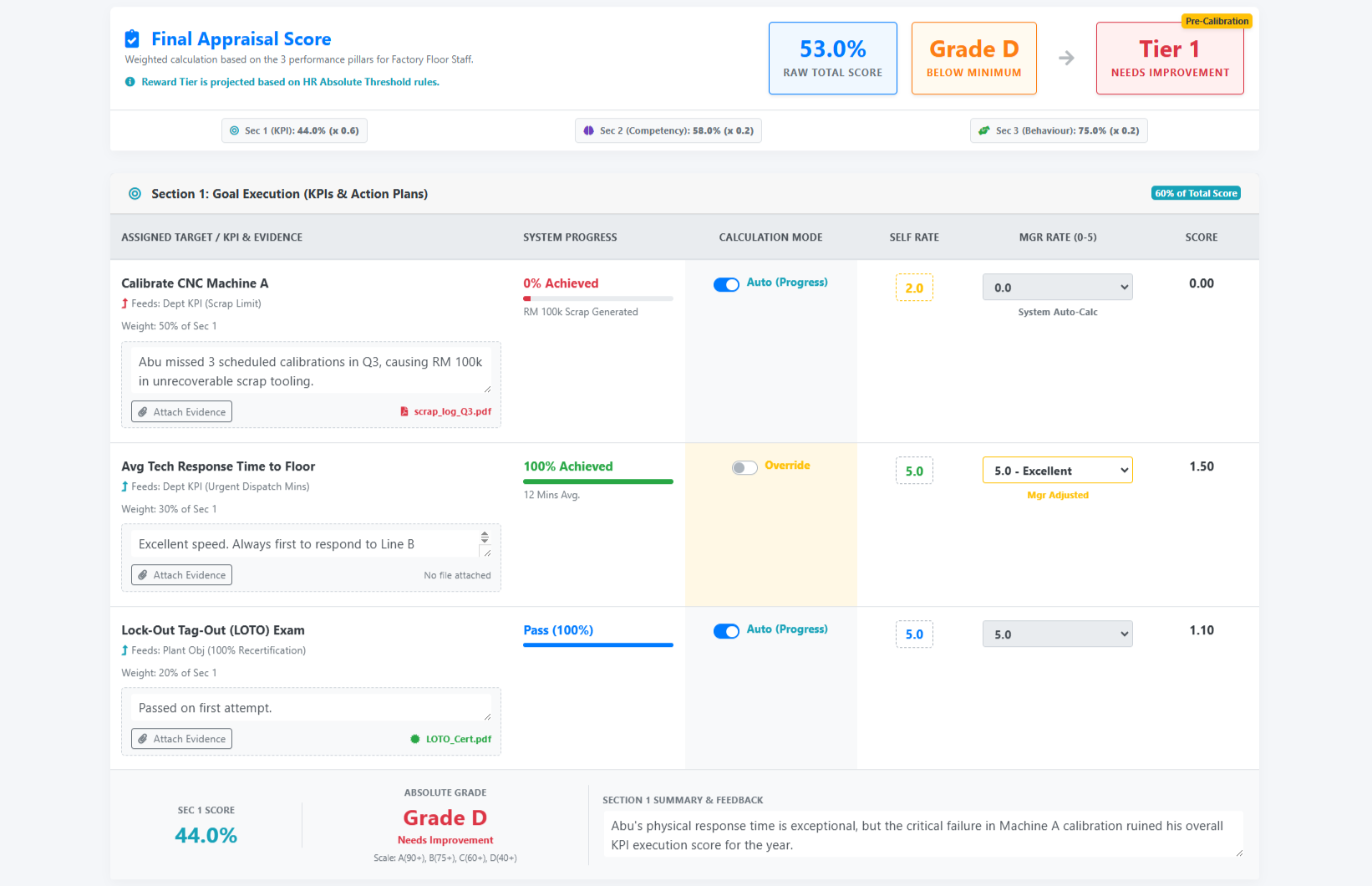
Three weighted pillars, auto-calculated from live KPIs. Then a bell curve and 9-Box calibration that strips out grade inflation before it reaches payroll.
Trusted by 100+ Organizations for KPI, HR, and Performance Management
DoerHRM supports organizations with KPI software, HR solutions, performance management, KPI training, coaching, and practical business improvement programs.









Built for Trust, Not Just Scoring
An Appraisal Nobody
Can Quietly Rewrite.
Every rating closes with a record the employee reviews, responds to and signs off on creating a clear, defensible history that HR and managers can reference at any point after the cycle closes.
Manager submits rating
Section scores, narrative feedback, and a Future Potential Assessment recorded — feeding straight into the 9-Box for succession planning.
Employee reviews & acknowledges
Year end summary of strengths, an actionable development plan, and employee comments captured before anything locks.
HR calibrates & locks
Confidential HR memo attached (hidden from employee). Signed, timestamped, and locked in order.
Three Weighted Pillars
One formula. No room for grade negotiation.
Every employee is measured against the same structure, adapted for their job family, so no one can argue the yardstick moved after the fact. The manager’s job is to review the evidence, not decide the grade.
Goal Execution
KPIs and action-plan completion synced automatically from the BSC and OKR modules scored from what actually happened, not what a manager thinks happened.
Technical & Role Competencies
Role-specific technical skills assessed by the employee and their line manager, grouped per job family and configured by HR.
Corporate Values & Behaviours
Company-wide values and behaviours rated by HR and line manager — the same rubric for every employee, regardless of role.
Inside the Appraisal
Every part of the score,
built to be trusted.
An appraisal only works if the manager, the employee and HR can all trust what’s on the page. Here’s what makes that possible.
1
Scored from the system, not from memory
KPI progress is pulled from live data, so a rating never comes down to what a manager remembers happening months later.
2
Self-rating sits next to manager-rating
Every competency shows both sides before a final score is set not just the manager’s version of events.
3
One rubric, every employee
Values and behaviours are scored the same way company-wide, so standards don’t quietly shift from team to team.
4
Ends with a plan, not just a verdict
Every cycle closes with named training, a due date and a status pointing the employee forward, not just scoring them backward.
Bell Curve Calibration
Enforce the curve.
Stop grade inflation.
Managers naturally want to rate everyone well but that inflates bonuses and hides who your real top performers are. DoerHRM fixes the curve automatically, without punishing anyone who’s genuinely earned a high score.
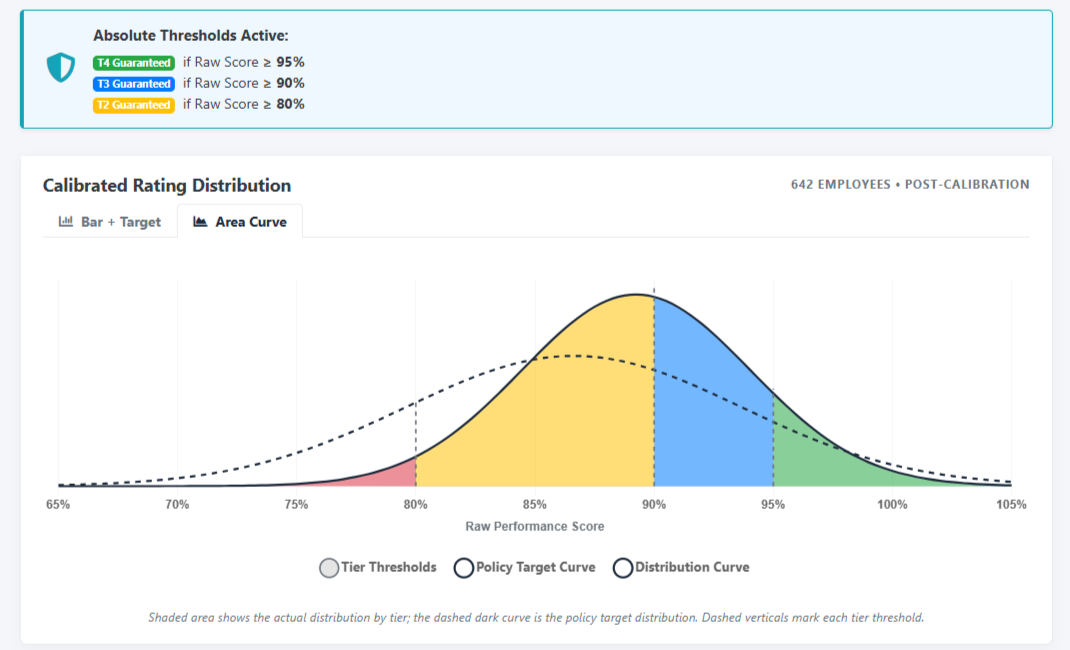
Three guaranteed tiers 95%, 90% and 80% raw score so a genuinely strong result can’t be dragged down by a bad curve.
Switch between Bar + Target and Area Curve to see the actual distribution against HR’s policy target, live.
Succession Planning
Spot future leaders
with the 9-Box Matrix.
Appraisal score (Performance) maps against Manager-rated Potential to automatically plot every employee into the 9-Box Matrix — no more debating potential in spreadsheets.
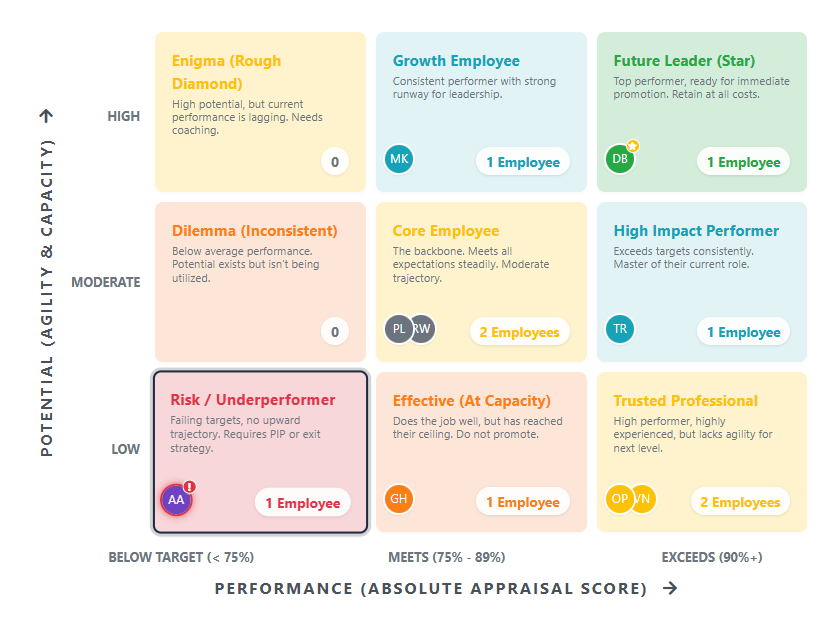
Future Leader (Star): high-potential, high-performers ready for immediate promotion.
Core Employee: steady performers requiring retention plans.
Risk / Underperformer: a 60-day PIP, freezing rewards, and role reassessment.
Everything You Need
From self-assessment to calibration-ready
Auto + Override
Section 1 scores are auto-fed from live KPI data by default — managers can override any score with a logged reason and full audit trail.
Enforced Bell Curve
Standardise manager appraisals against a company-wide target distribution to stop grade inflation.
9-Box Matrix Plotting
Employees mapped automatically by potential and performance into nine succession categories.
Actionable Development Plan
Every appraisal cycle ends with training actions, categories, due dates and status — not just a score.
Budget Warning Indicators
Real-time warnings when calibrated ratings would exceed pre-set payroll budget limits.
Full Calibration Audit
Every override is logged with its reason — Budget Adjustment, HR Overridden, or Approved.
Frequently Asked Questions
Frequently Asked Questions
about Appraisal & Analytics
Bell curve performance rating forces a workforce’s ratings into a target distribution (e.g. a fixed share of Outstanding, Good, Average, Below) so managers can’t rate everyone at the top. DoerHRM uses a hybrid model: ratings generally follow the target curve, but any score above a set absolute threshold guarantees top-tier placement regardless of the curve.
DoerHRM computes a weighted Final Appraisal Score from three sections: Goal Execution (KPI progress, typically 60%), Technical & Role Competencies (typically 20%), and Corporate Values & Behaviour (typically 20%). Section 1 pulls each KPI’s actual system progress automatically; managers can override any score, but every override is logged and visibly flagged.
HR sets absolute score thresholds once — for example, a score of 95% or above locks in an “Outstanding” grade — and the system assigns each employee’s grade and projected reward tier automatically. No manager negotiates a grade; it is calculated the same way for everyone, then confirmed during calibration.
A 9-box talent matrix plots employees on two axes — performance and potential — to sort them into nine categories for succession planning, from top talent to underperformers. DoerHRM builds this automatically for every employee by combining their appraisal score with their manager’s Future Potential Assessment, from “Future Leader (Star)” to “Risk / Underperformer”.
Clicking the Risk/Underperformer quadrant shows every employee placed there along with HR-recommended actions, such as initiating a 60-day Performance Improvement Plan (PIP), freezing rewards, and considering role reassessment. Succession and management-out decisions can be exported directly from the matrix, or distributed to managers.
Yes. Every appraisal closes with a locked electronic signature workflow — manager first, then employee, then HR calibration — plus employee comments and acknowledgement before anything is finalised. A confidential HR memo stays hidden from the employee throughout, so sensitive notes never appear on the record they see.
Yes. Managers can override any auto-calculated score, but must enter a justification. The original system score is preserved and every override is visibly flagged, so nothing is hidden from HR during calibration.
Yes. DoerHRM is free for up to 3 users and includes a 14-day full-feature trial with no credit card required.
Stop debating scores.
Start trusting them.
Get a live walkthrough of DoerHRM’s appraisal engine, bell curve and 9-Box calibration on your own workforce.