Turning business strategy into measurable results means connecting four things: clear company priorities, OKRs that set the change you want, KPIs that track ongoing performance, and a weekly rhythm of check-ins. Most companies already have goals and KPIs. What they usually miss is the link between strategy, departmental priorities, individual accountability and disciplined execution.
Key takeaways
- KPIs help you manage today’s business. OKRs help you build a better tomorrow. Use them together.
- A good OKR is one meaningful Objective plus 2 to 5 measurable Key Results: results, not activities.
- Department OKRs should support company priorities, not simply copy them.
- Goals fail without execution: set priorities, define Key Results, pick initiatives, check in weekly, review quarterly.
- For second-generation leaders, a clear OKR and KPI system reduces the business’s dependence on the founder.
By Ng Shone Fone, Founder and CEO of DoerHRM, Certified HRD Corp Trainer, with 30 years in business.
What happened at our latest 2-day OKR and KPI workshop?
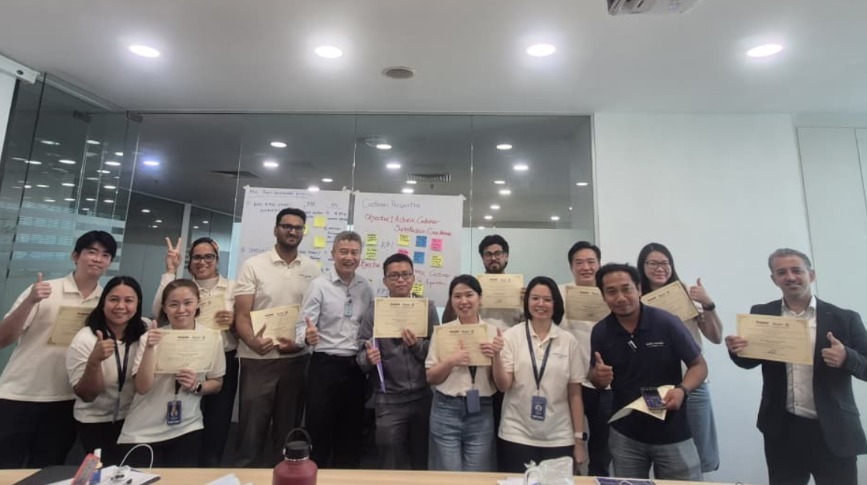
We have just completed another 2-day OKR & KPI Setting and Performance Management Mastery Workshop, full of thought-provoking questions, lively discussions, hands-on exercises and plenty of laughter.
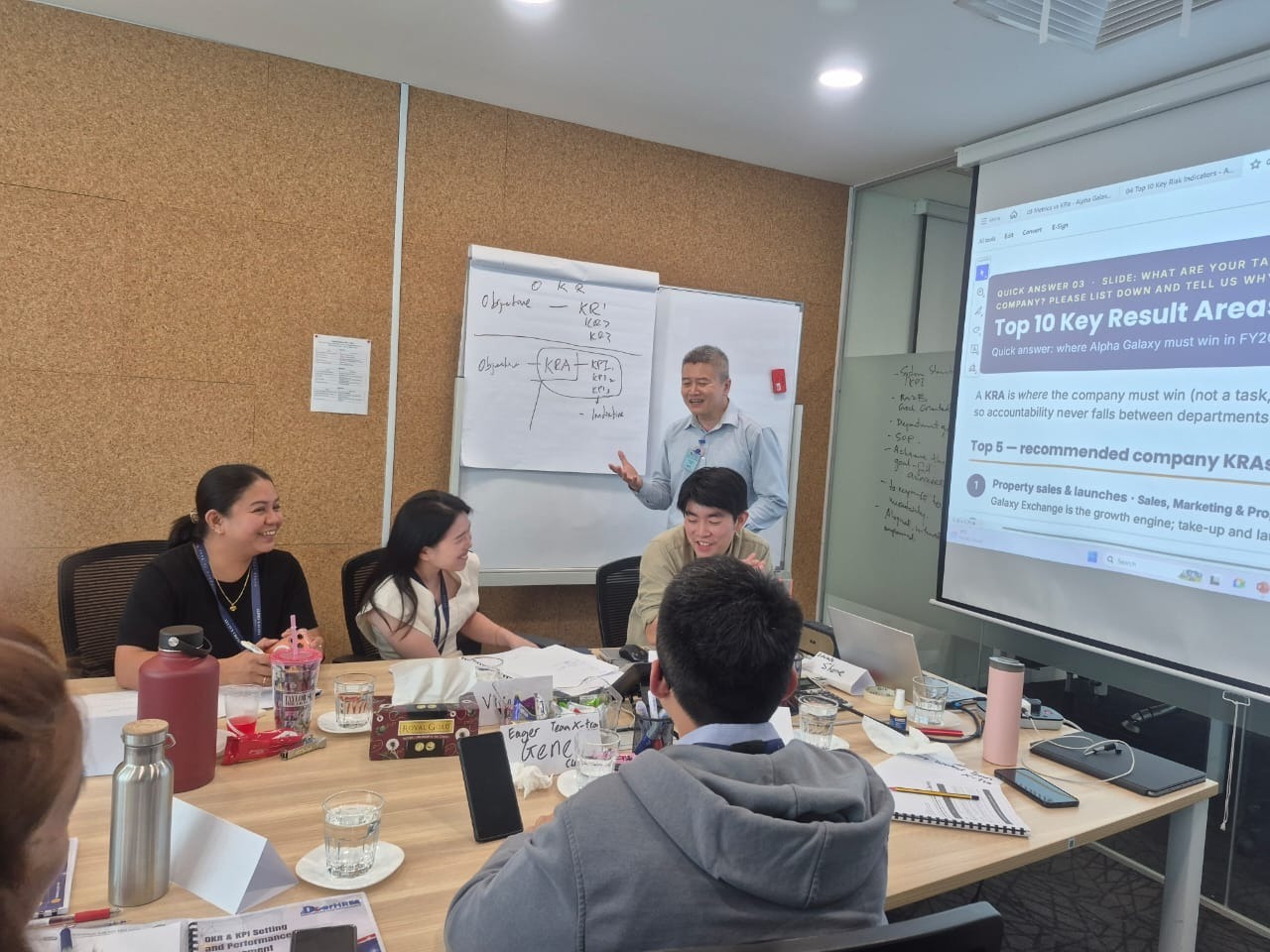
We had a wonderful group of participants who came with different experiences, perspectives and business challenges. What made this workshop particularly meaningful was having a second-generation business leader among them.
I always find it encouraging to see the next generation stepping forward, embracing new management approaches and preparing to take their businesses to greater heights.
For many growing businesses, especially family-owned companies, the challenge is no longer just about working harder or growing sales. It is about building a management system that lets the business grow sustainably, with clearer direction, stronger accountability and less dependence on the business owner.
Over the two days, we explored how to translate business ambitions into meaningful objectives, set measurable KPIs, align departmental priorities and, most importantly, turn plans into action.
And what a lovely way to wrap up the workshop: a 5-star Google review from one of our participants, Tasneem.
“Excellent training with clear guidance on OKR and KPI setting and performance management. Highly recommend for management level who wants to improve company performance and set the right direction.”
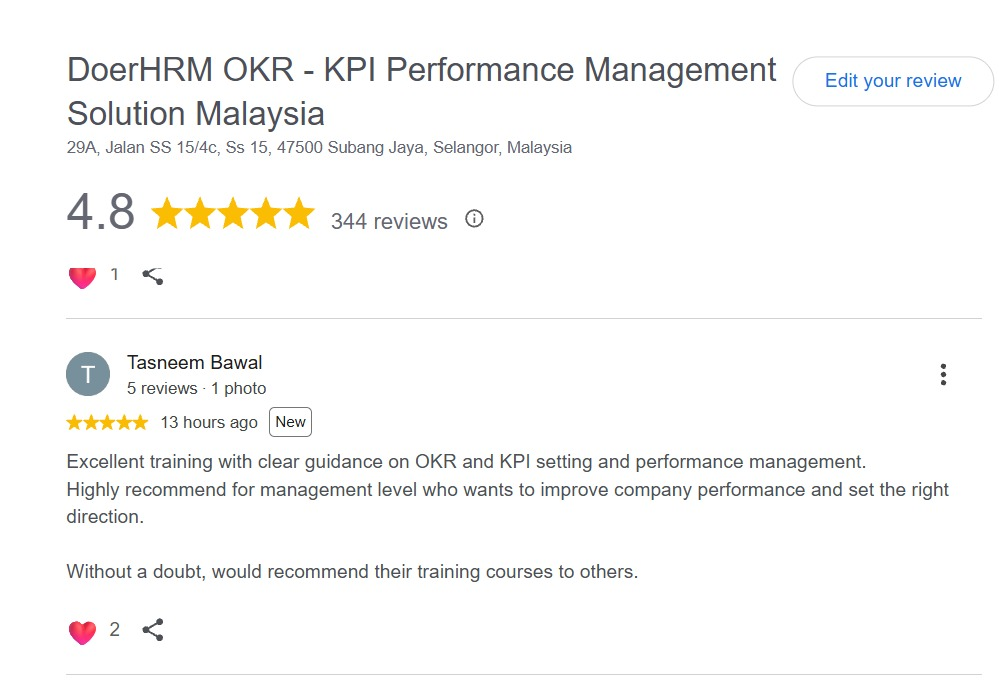
Thank you, Tasneem, for the encouraging words.
As a trainer and business owner, my greatest satisfaction is not simply seeing participants understand the concepts. It is seeing them gain the clarity and confidence to put what they have learned into practice. Knowledge alone does not improve business performance. What matters is what we do with it.
Why do companies have KPIs everywhere but still miss their goals?
Because the problem is rarely a lack of goals or measurements. It is the missing connection between strategy, departmental priorities, individual accountability and disciplined execution.
Many companies have strategic plans. Most departments have KPIs. Employees attend performance reviews, and management receives monthly reports. Yet a familiar problem remains: the numbers are tracked, but the strategy does not move.
Here are the key concepts and practical approaches we explored during the workshop.
What is the difference between OKRs and KPIs?
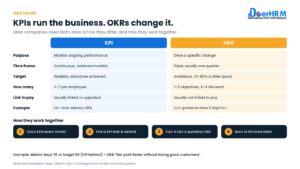
An OKR (Objectives and Key Results) focuses on a meaningful change or breakthrough improvement. A KPI (Key Performance Indicator) measures the ongoing health of important processes and results. They serve different purposes and work best together.
| OKR | KPI |
|---|---|
| What do we want to change or achieve? | How well are we performing? |
| Focuses on strategic improvement | Focuses on ongoing performance |
| Often quarterly | Monitored continuously |
| Encourages ambitious progress | Maintains performance standards |
| Measures progress towards an objective | Tracks critical business results |
For example, a company may have an on-time delivery KPI target of 95%, but its current performance is only 88%. The KPI identifies the gap. An OKR helps the organisation focus on closing that gap through coordinated improvements.
The key lesson: KPIs help us manage today’s business, while OKRs help us build a better tomorrow. For a deeper comparison, read our guide to OKR vs KPI.
How do you write an effective OKR?
A good OKR has one qualitative Objective supported by 2 to 5 measurable Key Results. Use the formula: “I will [Objective], as measured by [Key Results].”
The Objective should be meaningful and inspiring, and clearly describe what the organisation wants to accomplish. Key Results should be measurable outcomes, not activities or tasks.
Example: company-level OKR (illustrative)
Objective: Become our customers’ most reliable partner.
- KR1: Increase on-time delivery from 88% to 95%.
- KR2: Improve customer satisfaction from 3.9 to 4.3 out of 5.
- KR3: Reduce customer complaints by 30% compared with the previous quarter.
The Objective describes the desired outcome, while the Key Results give measurable evidence of success. Compare these two statements:
- Activity: Conduct customer service training for employees.
- Key Result: Improve customer satisfaction from 3.9 to 4.3 out of 5.
Training may be an important initiative, but the real result is improved customer satisfaction. Being busy is not the same as being productive. Completing activities is not the same as achieving results. More on the basics in what is OKR.
How do you cascade company OKRs to departments?
Each department writes its own OKR that supports a company Objective, instead of copying the company’s Key Results. This shows every team how its work contributes, and gives it ownership of measurable outcomes.
One common weakness in performance management is that company goals are set at the top, but employees struggle to see how their work contributes to them. Continuing the example:
Company Objective: Become our customers’ most reliable partner.
Operations department Objective: Deliver every order right the first time, on time.
- KR1: Reduce average order lead time from 10 to 7 days.
- KR2: Achieve a first-pass quality rate of 98%.
- KR3: Reduce unplanned downtime by 25%.
These results directly support the company’s reliability ambition. Other departments contribute through their own priorities: Sales by understanding customer commitments, Procurement through supplier reliability, and Customer Service by resolving issues promptly.
The important principle: department OKRs should be aligned with company priorities, not simply copied from them.
How do you turn OKRs into weekly execution?
Use a simple execution rhythm: set a few clear priorities, define measurable Key Results, choose the initiatives that move them, check progress every week, and review and learn every quarter.
Even a well-written OKR fails when it becomes just another document. A common scenario: management holds an annual strategy meeting, departments submit their targets, and everyone returns to daily work. Three months later, little has moved. Goals were set, but execution was not managed.
- Set clear priorities. Choose three to five meaningful Objectives per team per cycle. Not every operational responsibility needs to become an OKR.
- Establish measurable Key Results. Give each Objective about two to five Key Results, each with a baseline, target, owner and deadline.
- Identify the initiatives. Decide which projects will influence each Key Result. For example, reducing delivery lead time may need workflow redesign, better scheduling or supplier coordination.
- Hold weekly check-ins. Each owner answers three questions: What progress have we made? What is stopping us from reaching the target? What must we do before the next review? Focus on solving problems and making decisions, not just reporting numbers.
- Review and learn every quarter. Compare results with targets, identify what worked and what did not, and use the lessons to improve the next cycle.
Some organisations score ambitious OKRs from 0.0 to 1.0, with 0.7 sometimes representing meaningful progress on a stretch goal. Agree the scoring rules clearly, and do not treat a stretch OKR like a committed KPI used for individual appraisal or rewards.
How do OKRs, KPIs and performance management fit together?
They should form one system, not separate exercises: company strategy flows into company and department OKRs, then individual accountability, regular check-ins, performance reviews and continuous improvement, with KPIs tracking the health of the business throughout.
Company strategy → Company OKRs → Department OKRs → Individual accountability → Regular check-ins → Performance reviews → Continuous improvement
KPIs stay important throughout, because they show the ongoing health of the business. Performance reviews should consider not only whether targets were achieved, but also the quality of execution, collaboration, capabilities developed and the factors within each person’s control. See how KPI performance management and a fair performance appraisal connect.
When these elements work together, performance management becomes more than an appraisal exercise. It becomes a management system that helps everyone understand what matters, what success looks like and what needs to happen next.
Why does this matter for second-generation business leaders?
Because a business that depends on the founder for every decision is hard to grow. Clear OKRs and KPIs build priorities, accountability and transparency into the system, so the company can execute consistently with less dependence on any one person.
For many family businesses, the founder’s entrepreneurial drive, experience and personal involvement built the company. But as the business grows, the strengths that made it successful can become limits. When too many decisions depend on the founder, growth becomes hard to sustain.
The next generation faces a different challenge. It is no longer just about growing the business through personal effort. It is about building a company where people, processes and systems consistently deliver results.
The goal is not to replace entrepreneurial judgement with paperwork. It is to build a business that can execute consistently, even when the owner is not personally involved in every decision. To me, that is an important step in taking a business from one generation of success to the next.
How does DoerHRM support strategy execution?
We focus on three elements: clarity, alignment and execution, through OKR and KPI workshops, performance management consulting and the DoerHRM software platform.
We help organisations:
- Translate business strategy into measurable objectives.
- Align company, department and individual goals.
- Develop practical KPI scorecards and OKRs.
- Monitor progress through performance dashboards.
- Strengthen accountability through regular check-ins and performance reviews.
- Build a more transparent, results-oriented performance culture.
In DoerHRM, the OKR strategy execution module links company, department and individual OKRs, so progress is visible to everyone. Technology makes the process more visible and consistent, but the real transformation happens when leaders and employees build the discipline to execute.
Frequently asked questions
What is the difference between strategy and execution? Strategy decides where the company wants to go and what it must do differently. Execution is the day-to-day work of turning those priorities into results, through clear goals, owners, initiatives and regular reviews.
Should a company use OKRs or KPIs? Most companies need both. KPIs track the ongoing health of the business, such as on-time delivery or gross margin. OKRs focus effort on a few important changes, such as raising on-time delivery from 88% to 95% this quarter.
How many OKRs should a team have? Usually three to five Objectives per team per cycle, each with about two to five Key Results. Fewer, well-chosen OKRs are easier to execute than a long list.
How often should OKRs be reviewed? Check progress weekly in a short meeting, and review results and lessons at the end of each quarter.
Should OKR scores be linked to bonus? Generally no. Stretch OKRs are meant to be ambitious, so linking them to pay encourages safe targets. Base rewards on KPIs and the performance appraisal instead.
What does the OKR & KPI Setting and Performance Management Mastery Workshop cover? It is a 2-day, hands-on workshop on translating business ambitions into objectives, setting measurable KPIs, aligning department priorities and turning plans into action, with practical exercises and group discussion. See our KPI training page for details.
Final thought: from setting goals to achieving results
Strategy provides direction. OKRs create focus. KPIs measure performance. Disciplined execution delivers results.
Looking back at the two days of discussions, exercises and enthusiasm, I am reminded that the true value of training is not how much knowledge participants receive, but how much of it they put into action. The same applies to business strategy.
A company does not succeed simply because it has a strategic plan, an impressive dashboard or a long list of KPIs. Success comes when people understand their priorities, take ownership, review progress, solve problems and keep improving.
So the question for every business leader is not simply, “Have we set our KPIs?” It is: “Do we have a system that consistently turns our business goals into measurable results?”
Ready to move your organisation from strategy to execution? Request a customised OKR & KPI workshop proposal for your management team.
Ng Shone Fone is the Founder and CEO of DoerHRM and Group CEO of Obsnap. With 30 years in business, he is a Certified HRD Corp Trainer who helps Malaysian companies set clear, fair KPIs and turn strategy into results.