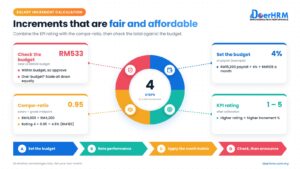
For a fair salary increment calculation in Malaysia, combine two things: the employee’s KPI rating (how well they performed) and their compa-ratio (how their salary compares with the midpoint for their job grade). A merit matrix turns these into an increment percentage, and a budget check keeps the total affordable.
Key takeaways
- Increment % = merit matrix (KPI rating × compa-ratio band).
- Compa-ratio = employee’s salary ÷ midpoint of the salary range for their grade.
- High performers paid below the midpoint get the biggest increase; people already paid well above it get less.
- Always check the total against the increment budget before announcing.
- Bonus rewards last year’s results; increment changes pay going forward. Keep the two decisions separate.
By Ng Shone Fone, Founder and CEO of DoerHRM, with 30 years in business.
Important: the numbers in this article are examples to help you design your own increment policy. Set your own percentages based on your budget, salary structure and company policy.
How do companies decide salary increments?
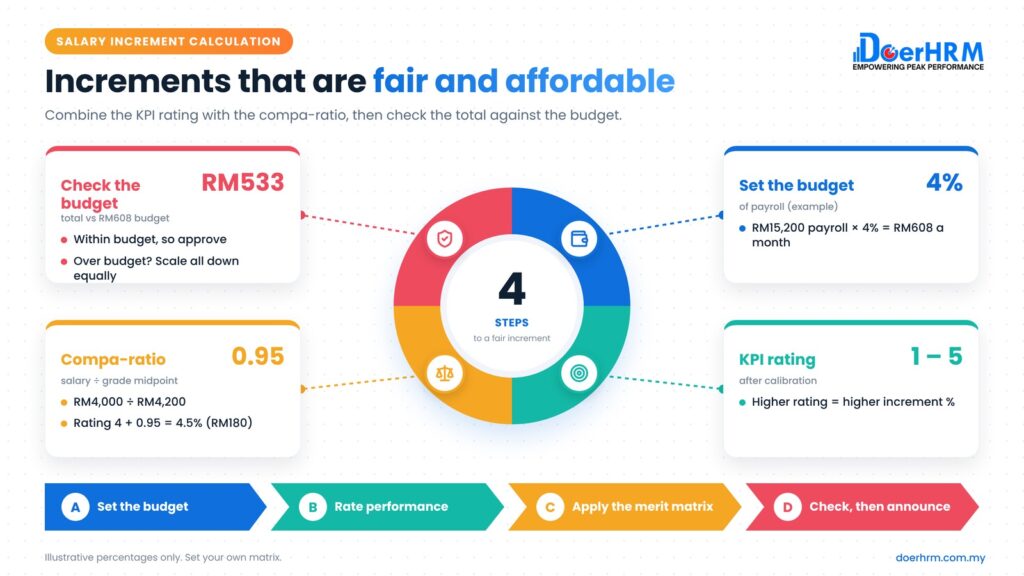
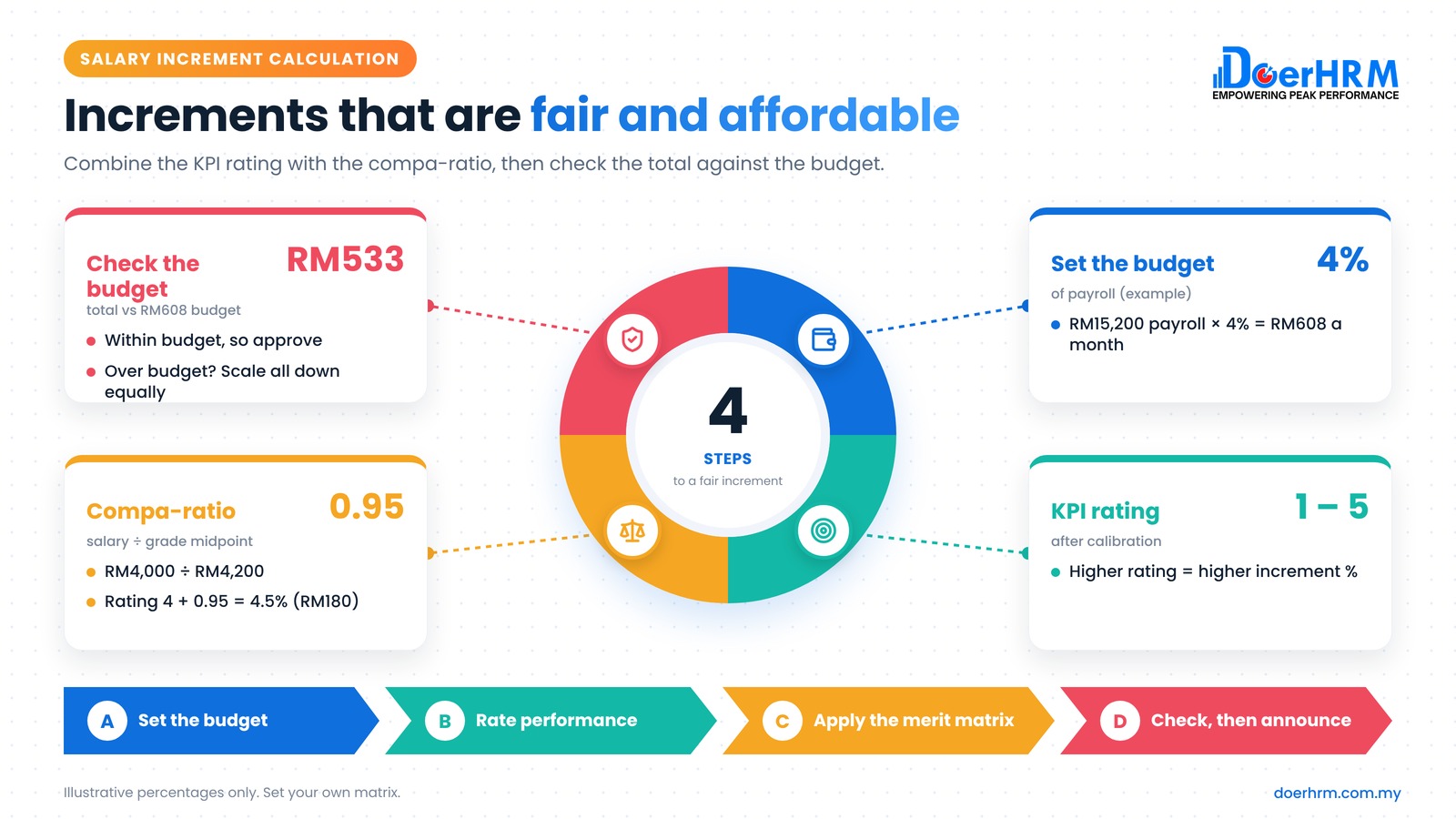
Most companies decide increments in 4 steps: set an overall increment budget, rate each employee’s performance, adjust for where their salary sits in the pay range, then check the total against the budget.
- Set the budget: for example, 4% of total payroll, based on company results and the market.
- Rate performance: use the final KPI and appraisal rating after calibration (see KPI performance management).
- Apply the merit matrix: rating × compa-ratio band gives the increment %.
- Check the budget and adjust before approval.
Is an annual increment compulsory in Malaysia? Generally not. The Employment Act 1955 does not require annual increments, so they are usually at the employer’s discretion. They become an obligation if the employment contract, company policy or a collective agreement promises them. The Industrial Court has enforced fixed increments written into collective agreements, and has accepted an employer’s decision not to pay increments where the agreement made them discretionary. Salaries must always stay at or above the national minimum wage. If unsure, check your contracts and policies with an employment law adviser.
What is compa-ratio?
Compa-ratio shows how an employee’s salary compares with the midpoint of the salary range for their job grade. Formula: compa-ratio = current salary ÷ grade midpoint.
- Below 0.9: paid low in the range (often newer staff)
- 0.9 to 1.1: paid around the midpoint
- Above 1.1: paid high in the range
Example: salary RM4,000, grade midpoint RM4,200 → compa-ratio 0.95.
The merit matrix (example)
A merit matrix gives a higher increment to better performers, and a bit more to those paid lower in their range.
| KPI rating | Compa-ratio below 0.9 | 0.9 – 1.1 | Above 1.1 |
|---|---|---|---|
| 5 – Outstanding | 8.0% | 6.0% | 4.0% |
| 4 – Exceeds | 6.0% | 4.5% | 3.0% |
| 3 – Meets | 4.0% | 3.0% | 2.0% |
| 2 – Partly meets | 1.5% | 1.0% | 0% |
| 1 – Below expectation | 0% | 0% | 0% |
Illustrative percentages only.
Salary increment calculation: worked example for 4 employees
Increment budget: 4% of the team’s monthly payroll (RM15,200 × 4% = RM608 a month).
| Employee (example) | KPI rating | Salary | Grade midpoint | Compa-ratio | Increment % | Increase | New salary |
|---|---|---|---|---|---|---|---|
| Aina | 4 | RM4,000 | RM4,200 | 0.95 | 4.5% | RM180 | RM4,180 |
| Ravi | 3 | RM3,000 | RM2,800 | 1.07 | 3.0% | RM90 | RM3,090 |
| Mei Ling | 5 | RM5,600 | RM5,000 | 1.12 | 4.0% | RM224 | RM5,824 |
| Hafiz | 2 | RM2,600 | RM3,000 | 0.87 | 1.5% | RM39 | RM2,639 |
| Total | RM15,200 | RM533 |
The total of RM533 is within the RM608 budget. Mei Ling is the top performer, but she is already paid above the midpoint, so her percentage is lower. Her ringgit increase is still the biggest. If the total had been over budget, you would reduce every increment by the same percentage, as in our bonus calculation guide.
How is increment different from bonus?
| Bonus | Increment | |
|---|---|---|
| What it rewards | Last year’s results | Ongoing contribution and market value |
| Paid | Once | Every month, from now on |
| Cost to company | One-time | Recurring, and compounds over years |
| Main driver | KPI rating and company profit | KPI rating, compa-ratio and market |
Because increments are permanent, many companies are more careful with them than with bonuses. Rewarding a one-off great year is usually better done through bonus or rewards and recognition.
Common increment mistakes
- Same % for everyone. High performers feel undervalued and may leave.
- Ignoring compa-ratio. Over time, long-serving average performers end up paid more than new high performers.
- No budget check. Totals creep above what the business can afford.
- Ratings not calibrated. One generous manager can skew the whole increment budget. Calibrate performance appraisal ratings across departments first.
- Unclear communication. Employees should understand how their increment was decided.
Frequently asked questions
How do companies decide salary increments? Most companies set an increment budget, rate each employee’s performance, use a merit matrix based on the rating and compa-ratio, and then check the total against the budget before approval.
What is a merit matrix? A merit matrix is a table that gives an increment percentage for each combination of performance rating and compa-ratio band. Better performers and those paid lower in their range get higher percentages.
What is compa-ratio? Compa-ratio is an employee’s salary divided by the midpoint of the salary range for their grade. A ratio of 1.0 means they are paid exactly at the midpoint.
Is salary increment compulsory in Malaysia? Generally no, unless promised in the employment contract, company policy or a collective agreement. Salaries must always meet the national minimum wage. If unsure, check with an employment law adviser.
What is a normal salary increment in Malaysia? It varies by industry, company results and individual performance. There is no fixed standard, so set your budget based on what your company can afford and market data from reliable salary surveys.
Should increment and bonus be decided at the same time? They can be decided in the same cycle, but as separate decisions. Bonus rewards last year’s results; increment changes pay going forward.
Conclusion
Use KPI ratings for performance and compa-ratio for pay position, combine them in a merit matrix, and always check the total against your budget. Keep the matrix simple, calibrate ratings first, and explain the method to employees.
Want to see how increments can be calculated automatically from calibrated KPI ratings? Book a free session with a DoerHRM expert. DoerHRM’s Bonus & Increment feature links appraisal results, grade multipliers and budget in one place.
Ng Shone Fone is the Founder and CEO of DoerHRM and Group CEO of Obsnap. With 30 years in business, he helps Malaysian companies link KPIs, appraisal and rewards.