To calculate bonus for employees in Malaysia, most companies use one of three methods: a fixed number of months’ salary, a KPI-based multiplier on a target number of months, or a share of a bonus pool. The fairest approach links each person’s bonus to their KPI rating while keeping the total within a budget the company can afford.
Key takeaways
- Method 1, fixed months: simple, but ignores individual performance.
- Method 2, KPI multiplier: bonus = basic salary × target months × multiplier from KPI rating.
- Method 3, bonus pool: shares a fixed amount based on salary and KPI rating, so the company never overspends.
- Always set a budget limit, and scale everyone’s bonus down proportionally if the total goes over.
- Bonuses are generally subject to EPF and PCB. Check the current rules with KWSP and LHDN.
By Ng Shone Fone, Founder and CEO of DoerHRM, with 30 years in business.
Important: the formulas and numbers in this article are examples to help you design your own bonus policy. Every company should set its own rules based on its finances, contracts and policies.
Is a bonus compulsory in Malaysia?
No. In general, a bonus is not required by law in Malaysia unless the employment contract, company policy or a collective agreement promises one. Most companies pay it at their discretion, based on company results and individual performance.
Because bonuses are discretionary, a clear written bonus policy matters. It is also the last step of KPI performance management. It tells employees how bonus is decided and protects the company from disputes. A good policy states:
- how the bonus budget is set (for example, a percentage of profit)
- who is eligible (for example, confirmed staff employed for the full year)
- how individual performance affects the amount
- when it is paid
Method 1: How do you calculate a fixed-months bonus?
A fixed-months bonus pays every eligible employee the same number of months of basic salary. Formula: bonus = monthly basic salary × number of months declared.
Example: the company declares a 1.5-month bonus. An employee earning RM4,000 a month receives RM4,000 × 1.5 = RM6,000.
| Pros | Cons |
|---|---|
| Simple to calculate and explain | High and low performers receive the same |
| Easy to budget | Weakens the link between KPIs and reward |
This method suits companies that do not yet have reliable KPI ratings. Once KPIs are tracked through the year, most companies move to Method 2 or 3.
Method 2: How do you calculate a bonus using KPI scores?
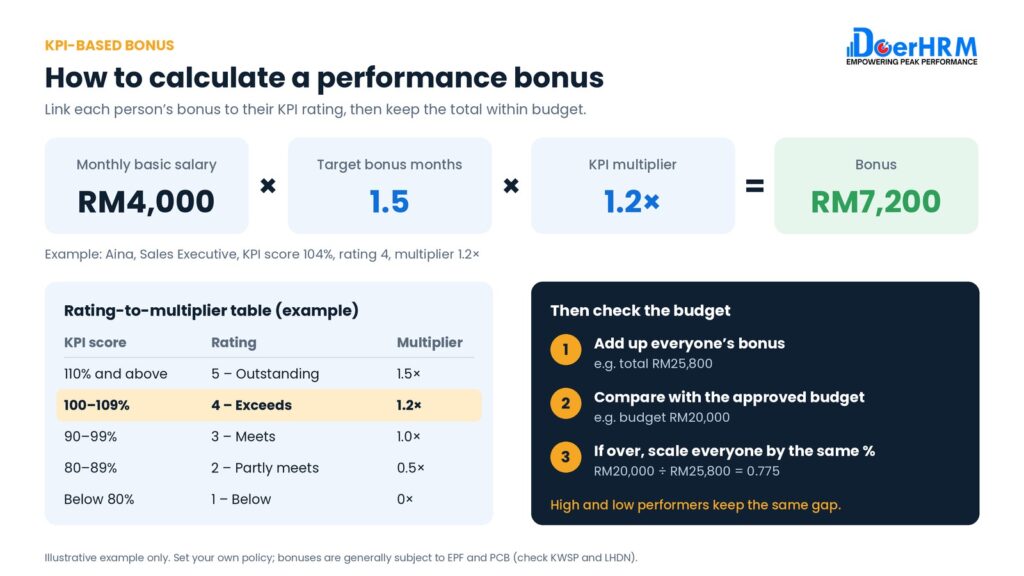
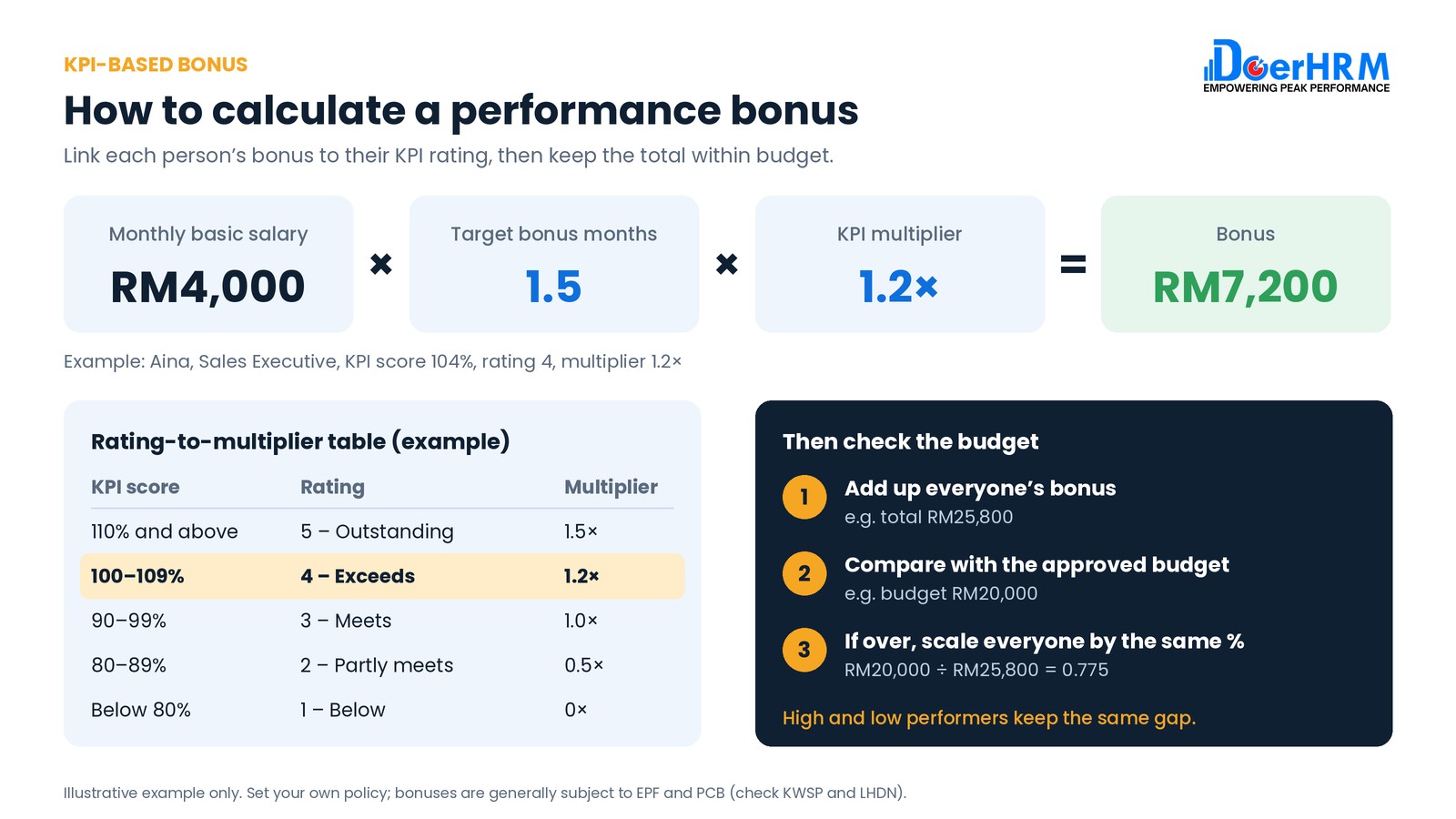
With the KPI multiplier method, each employee’s bonus depends on their KPI rating. Formula: bonus = monthly basic salary × target bonus months × multiplier from KPI rating.
First, agree a rating-to-multiplier table. Here is an example:
| KPI score | Rating | Bonus multiplier (example) |
|---|---|---|
| 110% and above | 5 – Outstanding | 1.5× |
| 100–109% | 4 – Exceeds | 1.2× |
| 90–99% | 3 – Meets | 1.0× |
| 80–89% | 2 – Partly meets | 0.5× |
| Below 80% | 1 – Below expectation | 0× |
Example: target bonus is 1.5 months. Aina, a Sales Executive earning RM4,000, scores 104% on her KPIs (rating 4, multiplier 1.2×).
Bonus = RM4,000 × 1.5 × 1.2 = RM7,200
The KPI score itself comes from weighted KPIs. See a worked example of how a weighted KPI score is calculated (in Bahasa Malaysia), or use our free KPI templates to calculate scores in Excel.
Watch out: if many people score highly, the total can exceed what the company can afford. That is why the next step, a budget limit, matters.
Method 3: How do you split a bonus pool?
With a bonus pool, the company first decides the total amount, then shares it based on each employee’s salary and KPI rating. Formula: individual share = (employee’s basic × multiplier) ÷ total of (basic × multiplier) for all employees × bonus pool.
Example: a team of 4 shares a pool of RM30,000. The multipliers come from the table above.
| Employee (example) | Monthly basic | Rating multiplier | Points (basic × multiplier) | Share of pool | Bonus |
|---|---|---|---|---|---|
| Aina, Sales Executive | RM4,000 | 1.2 | 4,800 | 27.9% | RM8,372 |
| Ravi, Accounts Executive | RM3,500 | 1.0 | 3,500 | 20.3% | RM6,105 |
| Mei Ling, Operations Supervisor | RM5,000 | 1.5 | 7,500 | 43.6% | RM13,081 |
| Hafiz, Admin Executive | RM2,800 | 0.5 | 1,400 | 8.1% | RM2,442 |
| Total | 17,200 | 100% | RM30,000 |
The total always equals the pool, so the company never pays more than planned. The trade-off is that individual amounts are only known once everyone has been rated.
How do you keep bonuses within budget?
Calculate everyone’s bonus with your chosen method, compare the total with the budget, and if it is over, scale every bonus down by the same percentage.
Example: using Method 2 (1.5 target months) for the 4 employees above gives a total of RM25,800. The approved budget is RM20,000.
Scaling factor = RM20,000 ÷ RM25,800 = 0.775
| Employee | Method 2 bonus | After scaling (× 0.775) |
|---|---|---|
| Aina | RM7,200 | RM5,581 |
| Ravi | RM5,250 | RM4,070 |
| Mei Ling | RM11,250 | RM8,721 |
| Hafiz | RM2,100 | RM1,628 |
| Total | RM25,800 | RM20,000 |
Everyone’s bonus is reduced by the same proportion, so the difference between high and low performers is kept. Recognition matters too: see how rewards and recognition work alongside bonus. In DoerHRM, reward calculation can simulate different budgets and multiplier tables before bonuses are approved.
What other factors should a bonus policy consider?
Beyond the formula, decide in advance how to treat new joiners, leavers, company results and minimum performance.
- Pro-rating: staff who joined mid-year often receive a share based on months worked (for example, 6 ÷ 12 of the full bonus).
- Company performance gate: many companies only pay bonus if the company reaches a minimum profit.
- Minimum rating: decide whether employees rated below “Meets” receive any bonus.
- Leavers: state whether staff who resign before the payment date are eligible.
- Calibration: review ratings across departments before calculating bonus, so one generous manager doesn’t distort the results. A 9-box talent review can help here.
Is bonus subject to EPF and PCB in Malaysia?
In general, yes. Bonuses are usually treated as wages for EPF contributions and as additional remuneration for PCB (monthly tax deduction). The rules and rates can change, so check the latest guidance from KWSP and LHDN before you pay.
Tell employees whether the bonus amount you announce is before or after deductions, to avoid confusion on payday.
Frequently asked questions
What is the formula for calculating a bonus? A common formula is: bonus = monthly basic salary × target bonus months × multiplier from the employee’s KPI rating. For example, RM4,000 × 1.5 months × 1.2 = RM7,200.
Is a bonus compulsory in Malaysia? Generally no, unless it is promised in the employment contract, company policy or a collective agreement. Most companies pay bonuses at their discretion.
How is bonus linked to KPI? Each employee’s KPI score is converted into a rating, and each rating has a bonus multiplier. Higher ratings receive a higher multiplier on the target bonus.
What is a bonus pool? A bonus pool is a fixed total amount set aside for bonuses, often a percentage of profit. It is shared among employees based on salary and performance, so the total never exceeds the budget.
How do you calculate bonus for a new employee? Many companies pro-rate the bonus by months worked. For example, an employee who worked 6 months receives 6 ÷ 12 of the bonus they would otherwise get.
Is a 2-month bonus normal in Malaysia? Bonus levels vary widely by industry, company results and individual performance. There is no standard amount; set yours based on what the company can afford and how performance is rated.
Is bonus taxable in Malaysia? Yes, bonus is generally taxable and subject to PCB. Check the latest rules with LHDN.
Conclusion
Start with a written bonus policy, choose a method that links bonus to KPI ratings, and always set a budget limit. Method 2 rewards performance clearly; Method 3 guarantees you stay within budget. Many companies combine them by calculating Method 2 and scaling to the budget.
Want to see how your bonus policy would work with your own KPI ratings? Book a free session with a DoerHRM expert and we’ll show you how reward calculation links KPI scores to bonus within your budget.
Ng Shone Fone is the Founder and CEO of DoerHRM and Group CEO of Obsnap. With 30 years in business, he helps Malaysian companies link KPIs, appraisal and rewards.