For most businesses, the top 3 KPIs cover growth, profitability and customers. Common choices are revenue growth, gross profit margin and customer retention rate. But the right three depend on your business model, so a trading company, a service firm and a factory will each pick different ones.
Key takeaways
- A useful top 3 covers one growth KPI, one profit KPI and one customer (or operations) KPI.
- Common starting point: revenue growth, gross profit margin, customer retention.
- Your business model changes the list. A factory may need on-time delivery more than retention.
- Three company KPIs are a focus tool. Departments and staff still need their own KPIs linked to them.
- Review your top 3 every month, and change them when your strategy changes.
By Ng Shone Fone, Founder and CEO of DoerHRM, with 30 years in business.
What are the 3 most common KPIs?
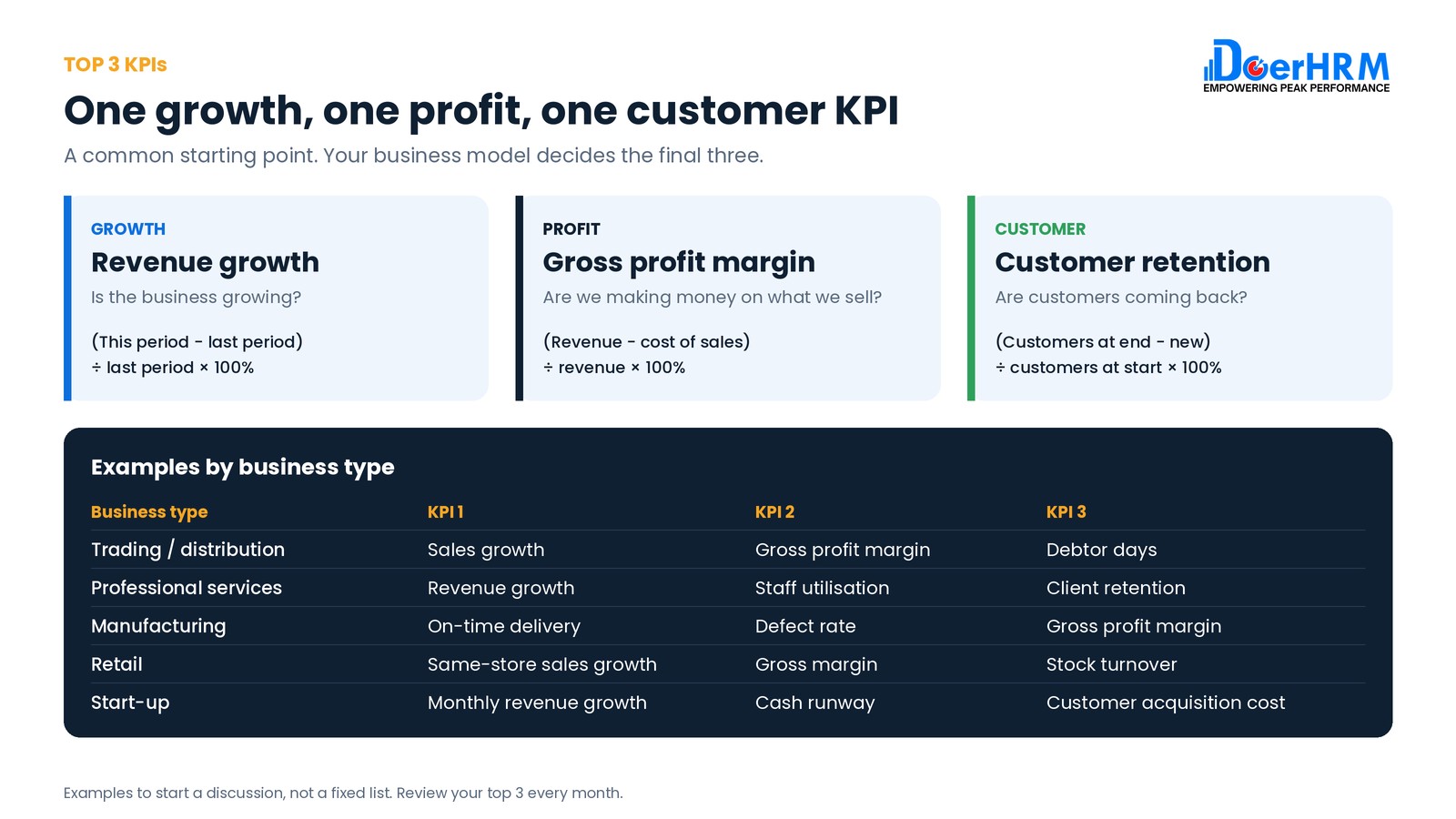
The 3 KPIs most businesses start with are revenue growth, gross profit margin and customer retention rate, because together they show whether the business is growing, making money and keeping customers.
| KPI | What it tells you | Formula |
|---|---|---|
| Revenue growth | Is the business growing? | (This period’s revenue − last period’s revenue) ÷ last period’s revenue × 100% |
| Gross profit margin | Are we making money on what we sell? | (Revenue − cost of sales) ÷ revenue × 100% |
| Customer retention rate | Are customers coming back? | (Customers at end − new customers) ÷ customers at start × 100% |
Why these three work together: revenue growth alone can hide shrinking profit. Margin alone can hide a business losing customers. Retention alone can hide slow growth. Watching all three gives a balanced view, the same idea behind the Balanced Scorecard.
Why do the top 3 KPIs depend on your business?
Different business models make money in different ways, so the numbers that matter most are different too.
In our KPI workshops, we ask management teams one question first: “If this number goes wrong, what breaks?” For a trading company, it is often cash tied up in stock and unpaid invoices. For a service firm, it is how much of your people’s time is billable. For a factory, it is delivering on time without defects.
| Business type | Top 3 KPIs (examples) | Why |
|---|---|---|
| Trading / distribution | Sales growth, gross profit margin, debtor days | Profit depends on margin, and cash depends on collecting on time |
| Professional services | Revenue growth, staff utilisation rate, client retention | People’s time is what you sell |
| Manufacturing | On-time delivery, defect rate, gross profit margin | Customers buy reliability; defects destroy margin |
| Retail | Same-store sales growth, gross margin, stock turnover | Sales per outlet and stock that moves |
| Start-up / early-stage | Monthly revenue growth, cash runway, customer acquisition cost | Survival depends on growth and cash |
These are examples to start a discussion, not a fixed list. Pick the three that best reflect your strategy this year.
What are the top 3 KPIs by department?
Each department should have its own top 3 that link to the company’s top 3. Here are common examples.
| Department | Top 3 KPIs (examples) |
|---|---|
| Sales | Sales vs target, gross margin on sales, new customers |
| Marketing | Qualified leads, cost per lead, lead-to-sale conversion rate |
| Finance | Debtor days, monthly reports on time, budget variance |
| HR | Staff turnover rate, time to fill vacancies, training hours per employee |
| Operations | On-time delivery, defect rate, cost per unit |
| Customer service | Complaints resolved within 24 hours, customer satisfaction score, first-contact resolution |
For more examples by role, see our employee KPI examples or KPI examples in Bahasa Malaysia.
How do you choose your top 3 KPIs? (4 steps)
Start from this year’s strategy, test each candidate KPI against 3 questions, and keep only the ones you will review every month.
- Write down this year’s 3 biggest goals. For example: grow sales in a new region, improve margin, and reduce late deliveries.
- List one measurable KPI for each goal. Use a formula, not a description.
- Test each KPI with 3 questions: Can we measure it every month? Can we influence it? Would a bad result change what we do?
- Set a baseline and target, then review monthly. If a KPI never triggers a decision, replace it.
Our SMART KPI guide explains how to write each KPI so it can be measured.
Worked example: two companies, two different top 3
These are hypothetical examples showing how two SMEs choose different KPIs.
A building-materials trading company (40 staff) found that sales were growing but cash was always tight. Its top 3: sales growth, gross profit margin and debtor days, because collecting invoices faster mattered more than retention.
An engineering consultancy (25 staff) had steady clients but thin profits. Its top 3: revenue growth, billable utilisation rate and client retention, because unbilled engineer hours were where profit leaked.
Same starting point, different answers, because each business has a different weak spot.
Why should most SMEs track fewer KPIs?
Tracking too many KPIs spreads attention thin. In our workshops, the companies that improve fastest focus on a few company KPIs and review them every month.
A long dashboard can feel thorough, but if nobody acts on 20 numbers, none of them matter. Start with 3 company KPIs, link department KPIs to them through KPI performance management, and add more only when the first three are reviewed reliably. For individual staff, 4 to 7 KPIs is usually enough.
Frequently asked questions
What are the top 3 KPIs? For most businesses, they are revenue growth, gross profit margin and customer retention rate. They show whether you are growing, profitable and keeping customers. The best three for your company depend on your business model and strategy.
What are the 5 key performance indicators? A common set of five adds a cash KPI (such as debtor days or cash flow) and an operations KPI (such as on-time delivery) to revenue growth, gross margin and customer retention.
How many KPIs should a business have? Most SMEs do well with 3 to 5 company KPIs, with each department having its own 3 to 5 KPIs linked to them. Individual employees usually need 4 to 7.
What is the most important KPI? There is no single most important KPI for every business. For many companies, gross profit margin is critical because growth without profit is not sustainable, but it depends on your situation.
How often should KPIs be reviewed? Review company and department KPIs every month. Review the choice of KPIs at least once a year, or whenever your strategy changes.
Conclusion
Start with one growth, one profit and one customer or operations KPI, then adjust them to your business model. Revenue growth, gross margin and customer retention are a good starting point, but your top 3 should reflect where your business is most likely to go wrong.
Want your management team to agree your company’s top 3 KPIs, and cascade them to every department? Request a customised KPI workshop proposal.
Ng Shone Fone is the Founder and CEO of DoerHRM and Group CEO of Obsnap. With 30 years in business, he helps Malaysian companies set KPIs and OKRs that drive results.