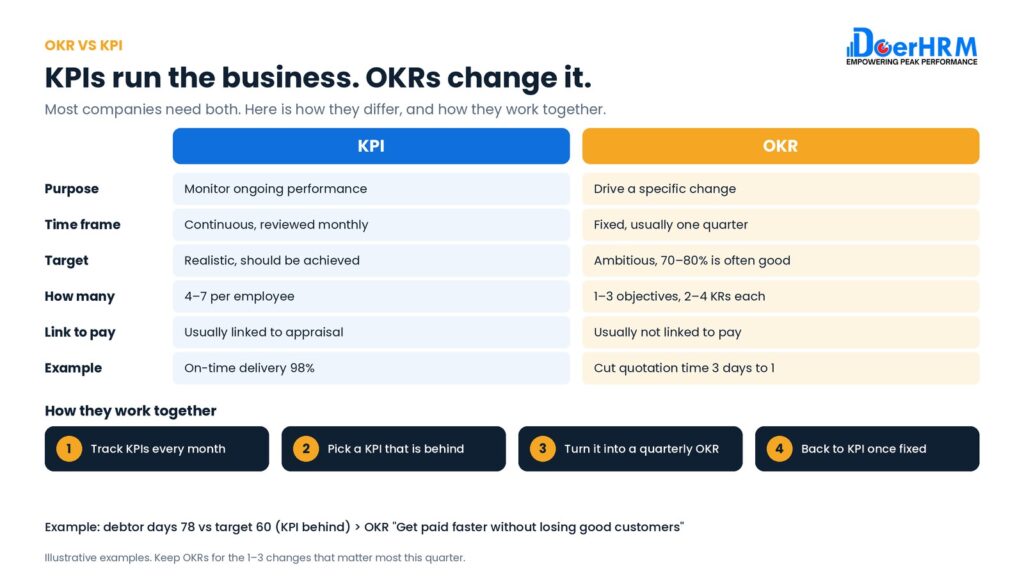
The difference between OKR and KPI is purpose: KPIs measure the ongoing health of your business, while OKRs (Objectives and Key Results) drive a specific change within a set period, usually a quarter. Most companies need both, with KPIs to run the business and OKRs to improve it.
Key takeaways
- KPI = a measure you track continuously, e.g. “on-time delivery 98%”.
- OKR = an ambitious goal plus 2–4 measurable results to reach in a quarter, e.g. “Become the fastest supplier in the Klang Valley”.
- KPIs tell you if something is wrong; OKRs are how you fix or change it.
- Use KPIs for appraisal and monthly reviews; use OKRs for priorities and projects.
- A KPI that falls behind often becomes the starting point for next quarter’s OKR.
By Ng Shone Fone, Founder and CEO of DoerHRM, with 30 years in business.
What is a KPI?
A KPI (Key Performance Indicator) is a number that shows whether an important part of the business is performing as expected. It is tracked continuously, usually every month, against a target.
Examples: monthly sales vs target, gross profit margin, complaints resolved within 24 hours. KPIs are the core of KPI performance management. KPIs are usually linked to performance appraisal, so each employee knows which results they are accountable for. Read our full guide on what a KPI is (in Bahasa Malaysia).
What is an OKR?
An OKR (Objective and Key Results) is a short-term goal-setting method: one inspiring Objective, supported by 2–4 measurable Key Results that show the objective has been achieved, usually within one quarter.
Example:
- Objective: Become the most responsive supplier for our top 20 customers
- Key Result 1: Cut average quotation time from 3 days to 1 day
- Key Result 2: Raise customer satisfaction from 4.1 to 4.5 out of 5
- Key Result 3: Launch WhatsApp order updates for all top 20 customers
OKRs became popular through companies such as Intel and Google, as described by John Doerr on What Matters. See our guide to what an OKR is for more examples.
What is the difference between OKR and KPI?
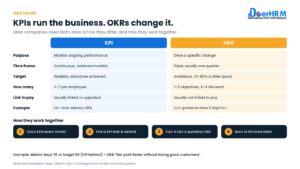
KPIs measure performance you want to maintain; OKRs set out change you want to achieve. The table below shows the main differences.
| KPI | OKR | |
|---|---|---|
| Purpose | Monitor ongoing performance | Drive improvement or change |
| Time frame | Continuous (monthly, quarterly, yearly) | Fixed period, usually a quarter |
| Target | Realistic, should be achieved | Ambitious; 70–80% achievement is often seen as good |
| Number | 4–7 per employee | 1–3 objectives, each with 2–4 key results |
| Link to pay | Usually linked to appraisal and bonus | Usually not linked to pay, to encourage ambition |
| Typical question | “Are we on track?” | “What must change this quarter?” |
| Example | On-time delivery 98% | Cut quotation time from 3 days to 1 |
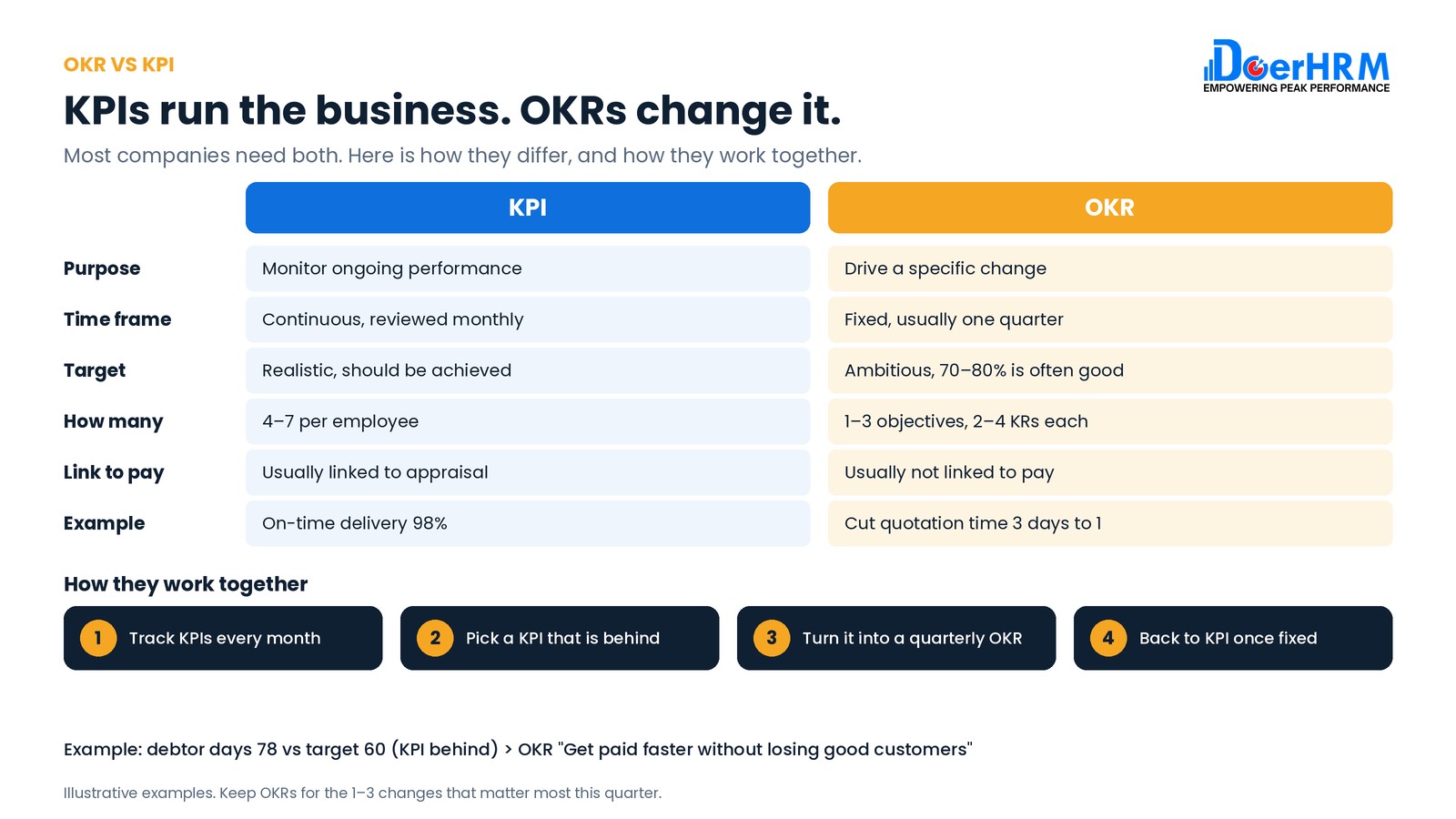
Can you use OKRs and KPIs together?
Yes. Most companies get the best results by using both: KPIs to run the business day to day, and OKRs to focus effort on the few things that must change this quarter.
A simple way to connect them:
- Track KPIs every month. They show where the business is healthy and where it isn’t.
- Pick the KPIs that are falling behind or that matter most to this year’s strategy.
- Turn each into a quarterly OKR. The objective describes the change; the key results describe how you’ll know it has happened.
- Move the improved result back into the KPI. Once the change sticks, the KPI target is updated and the OKR closes.
In our workshops, the biggest mistake we see is turning every KPI into an OKR. Keep OKRs for the 1–3 changes that matter most.
Example: KPI and OKR on one page
Here is an illustrative one-page example for the sales department of a Malaysian distribution company.
| KPIs (track monthly) | Target | Status |
|---|---|---|
| Monthly sales | RM400,000 | On track |
| Gross profit margin | 22% | On track |
| Debtor days | 60 days | Behind (78 days) |
| New customers | 6 a month | On track |
OKR for Q1 (because debtor days are behind):
- Objective: Get paid faster without losing good customers
- KR1: Reduce debtor days from 78 to 60
- KR2: Move the top 30 customers to a 30-day payment term with e-invoicing
- KR3: Hold a weekly collection review in 100% of weeks
When debtor days stay at 60 for three months, the OKR closes and the KPI target stays at 60.
Should OKRs be linked to appraisal and bonus?
Usually not directly. Linking OKRs to pay makes people set safe, easy goals. Link KPIs to appraisal and bonus, and judge OKRs on effort and learning.
Many Malaysian companies combine them like this: KPI results carry most of the appraisal weight, and OKR contribution is assessed as part of competencies or “initiatives”. In DoerHRM, KPIs and OKRs sit in the same system, so managers can see both without linking OKR scores directly to bonus.
OKR vs KPI: when should you use each?
| Situation | Use |
|---|---|
| Measuring routine work (sales, delivery, quality) | KPIs |
| Launching a new product, region or system | OKRs |
| A KPI has been behind for months | OKR to fix it |
| Annual appraisal and bonus | KPIs (plus competencies) |
| Aligning teams behind 2–3 company priorities | OKRs |
Frequently asked questions
What is the main difference between KPI and OKR? KPIs measure ongoing performance against a target, while OKRs set an ambitious objective and measurable key results to achieve a specific change, usually within a quarter.
Can a KPI be a key result? Yes. A key result is often a KPI with an improvement target, for example “reduce debtor days from 78 to 60”. The difference is that the key result has a deadline and is part of a change effort.
Should OKRs replace KPIs? No. OKRs don’t replace KPIs. Companies still need KPIs to monitor the business and to run fair appraisals. OKRs add focus on what must change.
Are OKRs linked to bonus? Usually not. Linking OKRs directly to bonus encourages easy targets. Most companies link KPIs to appraisal and bonus and use OKRs for priorities.
How many OKRs should a team have? Usually 1 to 3 objectives per quarter, each with 2 to 4 key results. More than that and focus is lost.
Is OKR suitable for Malaysian SMEs? Yes, if kept simple. Start with one company OKR per quarter, linked to your biggest KPI gap, before rolling OKRs out to every team.
Conclusion
KPIs tell you how the business is doing; OKRs help you change it. Track your KPIs every month, pick the one or two that matter most, and turn them into quarterly OKRs with clear key results.
Want help setting KPIs and OKRs that fit together for your company? Discuss your strategy alignment with a DoerHRM coach.
Ng Shone Fone is the Founder and CEO of DoerHRM and Group CEO of Obsnap. With 30 years in business, he helps Malaysian companies set KPIs and OKRs that drive results.