Good KPI training in Malaysia should leave your managers with finished KPIs for their own departments, not just notes. Choose a programme that uses your company’s goals, is practical, includes follow-up after the workshop and, if you pay the HRD Corp levy, is registered as HRD Corp claimable.
Key takeaways
- Judge KPI training by what participants produce, not by the number of slides or days.
- In-house training suits companies that want KPIs for their own departments; public courses suit 1–3 people learning the method.
- A 2-day workshop plus follow-up coaching works better than a 1-day course with nothing after it.
- If you pay the HRD Corp levy, check that the specific programme is registered and claimable before you book.
- Use the 10-question checklist below to compare providers.
By Ng Shone Fone, Founder and CEO of DoerHRM, and Certified HRD Corp Trainer with 30 years in business.
What should KPI training cover?
KPI training should teach managers to turn company goals into measurable KPIs for their own teams, set fair targets and weightage, and review KPIs every month. It should be hands-on, using your real goals.
A complete KPI programme covers 6 topics:
- Linking KPIs to strategy: starting from company goals, often using a Balanced Scorecard approach.
- Cascading: breaking company goals into department and individual KPIs.
- Writing good KPIs: formula, baseline, target, owner and review frequency. See what a KPI is for the basics.
- Weightage and scoring: how ratings are calculated and how to keep them fair.
- Monthly reviews: how to run a short check-in and agree actions when KPIs fall behind.
- Linking to appraisal and rewards: how KPI scores feed into performance reviews and bonus decisions.
If a programme only covers the theory of SMART KPIs, your managers will understand KPIs but still struggle to write them.
What should your managers produce by the end of the training?
By the end of a good KPI workshop, each department head should leave with a draft scorecard for their own department. That is the clearest sign the training worked.
From our workshops with Malaysian companies, these are the outputs to ask for:
| Output | What it is | Why it matters |
|---|---|---|
| Department scorecard | 5–8 KPIs per department, linked to company goals | Managers can start tracking the next month |
| KPI dictionary | Formula, data source, owner and review frequency for each KPI | Stops arguments about how a KPI is calculated |
| Weightage sheet | Weightage per KPI, adding up to 100% | Makes ratings consistent across departments |
| 30-day action plan | Who finalises which KPIs, and when the first review happens | Keeps momentum after the workshop |
Ask any training provider: “What will our managers walk out with?” If the answer is only “a certificate”, look elsewhere.
Public course or in-house training: which is better?
In-house training is better when you want KPIs built for your own company. A public course is better when only 1–3 people need to learn the method.
| Public course | In-house training | |
|---|---|---|
| Who attends | 1–3 people from different companies | Your managers together, typically 10–25 |
| Content | General examples | Your company goals and real departments |
| Output | Understanding of the method | Draft KPIs for your own departments |
| Alignment | Each person goes back alone | Managers agree KPIs together, across departments |
| Best for | HR staff learning to lead KPIs internally | Companies setting or resetting KPIs company-wide |
Many companies do both: send the HR lead to a public course or KPI certification first, then run an in-house workshop for department heads.
How long should KPI training in Malaysia be?
For department heads setting real KPIs, 2 days is a practical minimum, followed by coaching while the KPIs are put to use. One day is usually enough for awareness, but not for finished KPIs.
A format that works well:
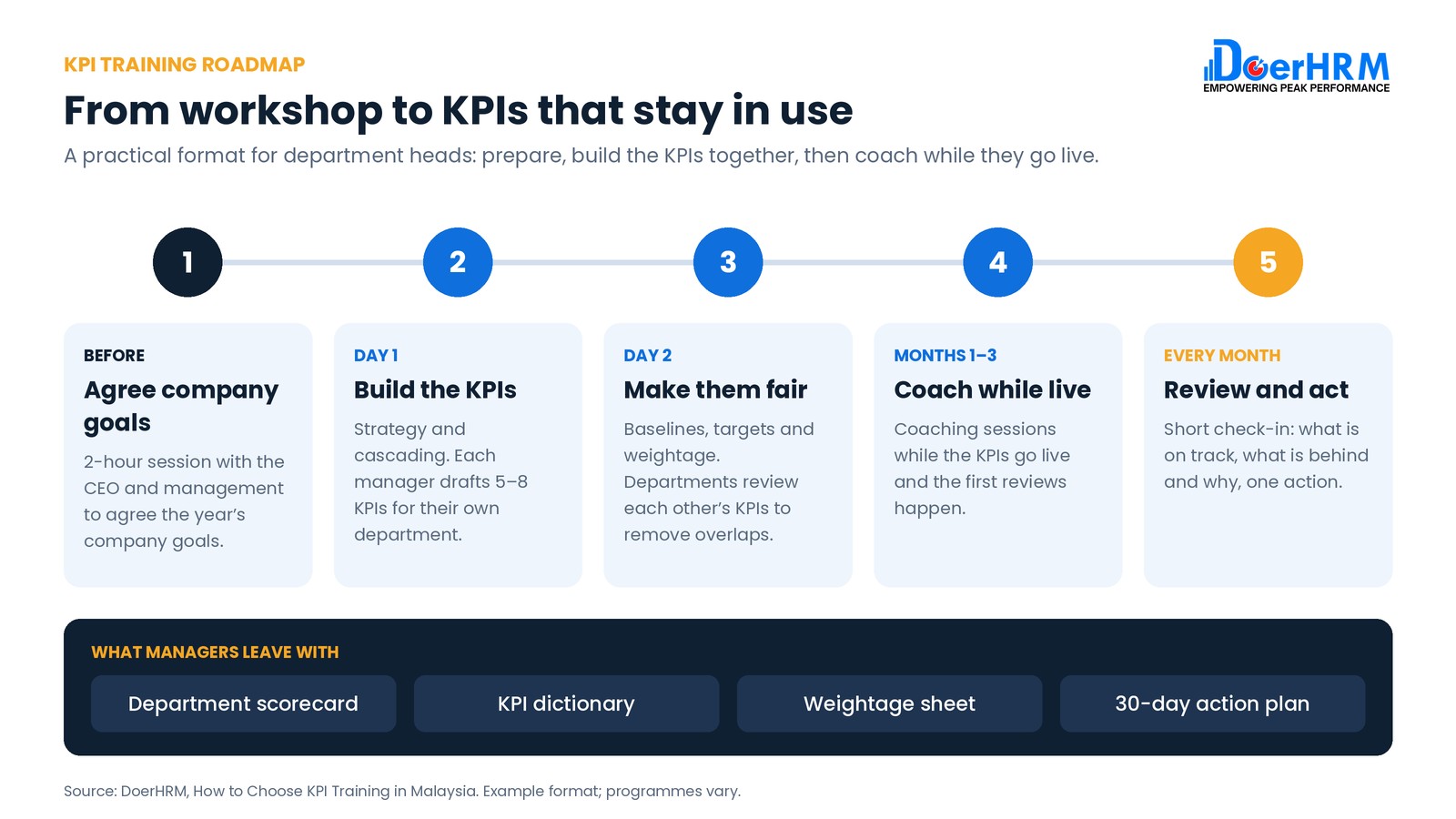
- Day 1: strategy, cascading and writing KPIs, with each manager drafting their own.
- Day 2: targets, weightage and scoring; departments review each other’s KPIs.
- Follow-up: coaching sessions over the next 1–3 months while the KPIs go live and the first monthly reviews happen.
For example, DoerHRM’s High Performance Training combines 2 days of face-to-face training with 3 months of online coaching.
Is KPI training HRD Corp claimable?
KPI training is HRD Corp claimable only when the specific programme and training provider are registered with HRD Corp. Always ask for the programme number and check it before you book.
Points to check with any provider:
- Is the training provider registered with HRD Corp?
- What is the programme number, and is it registered for the format you want (in-house or public)?
- Who prepares and submits the grant application, and how far in advance?
- Which costs are covered, and what will your company pay itself?
Rules and claimable costs can change, so check the current guidelines on HRD Corp’s claimable courses page.
DoerHRM’s High Performance Training is 100% HRD Corp claimable under programme number 10001154578.
10 questions to ask a KPI training provider
Use these questions to compare providers. A strong provider can answer every one with specifics.
- What will our managers produce by the end of the training?
- Will you use our company goals and departments, or generic examples?
- Who is the trainer, and what is their practical experience setting KPIs in companies?
- How long is the programme, and is there follow-up coaching after the workshop?
- Is the programme HRD Corp claimable, and what is the programme number?
- Can you show a sample output from a past workshop, with details hidden?
- How do you handle departments where results are hard to measure, such as admin or HR?
- How do you help us link KPIs to appraisal and bonus?
- What happens after the training? Is there a tool or template to track the KPIs?
- Can you run a short pre-workshop session with management to agree company goals first?
Why do KPIs fail after training, and how do you prevent it?
KPIs usually fail after training because nobody reviews them. Within a few months the scorecards sit in a folder until appraisal time. Plan the follow-up before the workshop starts.
In our experience, 3 things keep KPIs alive after training:
- A fixed monthly review date in every manager’s calendar, starting the month after the workshop.
- One place to track KPIs: a shared KPI template for small teams, or KPI software once several departments update every month.
- Coaching for the first 3 months, so managers get help when their first reviews show gaps.
Worked example: a 2-day workshop for 20 department heads
This is a hypothetical example of how an in-house programme can be structured for a 300-staff manufacturing company.
- Before the workshop: a 2-hour session with the CEO and management to agree 4 company goals for the year.
- Day 1: 20 department heads learn cascading and each drafts 5–8 KPIs linked to the company goals.
- Day 2: managers set baselines, targets and weightage, then review KPIs across departments to remove overlaps (for example, sales and production both claiming “on-time delivery”).
- Output: 20 draft department scorecards, a KPI dictionary and a 30-day plan.
- Follow-up: monthly coaching for 3 months while the first reviews take place.
Frequently asked questions
How much does KPI training cost in Malaysia? Costs depend on format, length and number of participants. In-house programmes are usually quoted per programme and public courses per participant. If the programme is HRD Corp claimable, part or all of the cost may be claimed from your levy.
Is KPI training HRD Corp claimable? Only if the specific programme and provider are registered with HRD Corp. Ask the provider for the programme number and check the current HRD Corp guidelines before booking.
Who should attend KPI training? Department heads and managers who set and review KPIs, plus the HR team who will coordinate the KPI process. Senior management should attend at least the session where company goals are agreed.
How long does KPI training take? Awareness sessions can run for half a day or a day. Training where managers finish real KPIs for their departments usually takes 2 days, followed by coaching.
What is the difference between KPI training and KPI certification? KPI training helps your managers set KPIs for your company. KPI certification is for individuals, usually HR or performance professionals, who want a recognised qualification to lead KPI work.
Can KPI training be done online? Yes. Online sessions work well for learning the method and for follow-up coaching. Face-to-face workshops are usually better when departments need to agree KPIs together.
Conclusion
Choose KPI training by what your managers will produce: department scorecards, a KPI dictionary and a plan for monthly reviews. Prefer in-house training when you want KPIs for your own company, check the HRD Corp programme number before booking, and plan coaching after the workshop so the KPIs stay in use.
Want your managers to leave the workshop with finished KPIs for their own departments? Request a customised KPI workshop proposal for your company.
Ng Shone Fone is the Founder and CEO of DoerHRM and Group CEO of Obsnap. With 30 years in business and an Executive MBA, he is a Certified HRD Corp Trainer who has helped Malaysian companies set and run KPIs and OKRs.