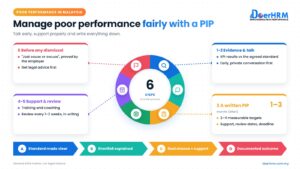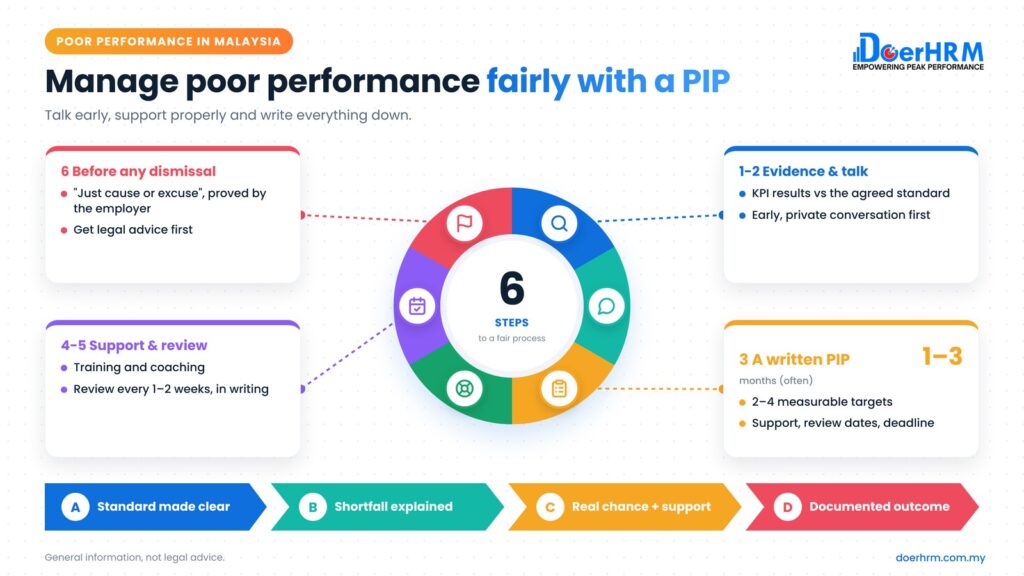
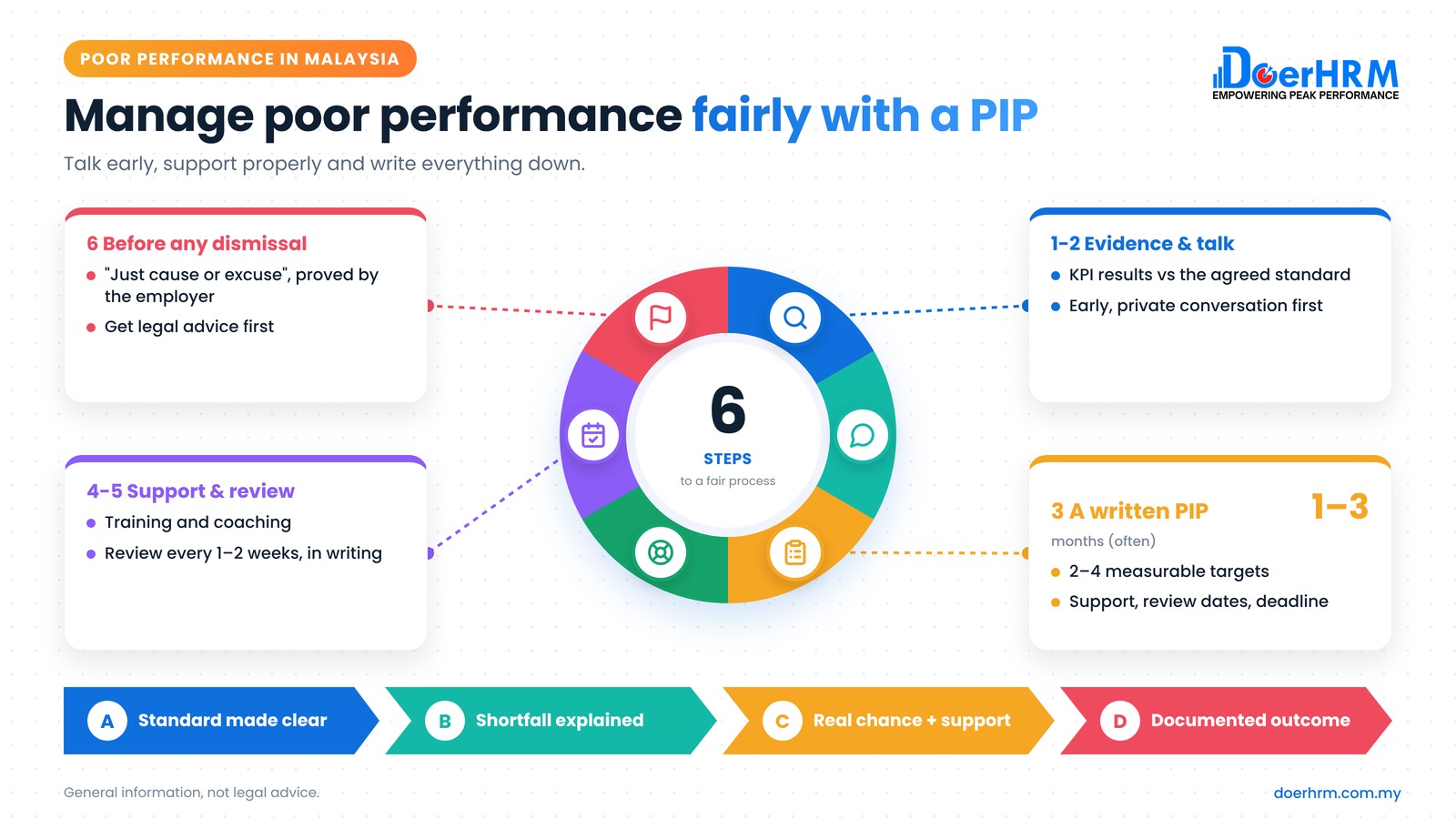
To manage poor performance in Malaysia fairly, tell the employee clearly what standard is expected, show evidence of the gap, agree a performance improvement plan (PIP) with measurable targets, support and a deadline, review progress regularly, and document every step. Most performance problems can be fixed this way, before any disciplinary action is considered.
Key takeaways
- Poor performance (can’t meet the standard) is different from misconduct (won’t follow the rules). Handle them differently.
- Start with a conversation and evidence. A PIP should not be the first time the employee hears about the problem.
- A good PIP has clear KPIs, support, a realistic timeline (often 1–3 months) and regular reviews.
- Document everything: expectations, evidence, support given and progress.
- Before any termination, get advice. The process must be fair, and the rules are strict.
By Ng Shone Fone, Founder and CEO of DoerHRM, with 30 years in business.
This article is general guidance for managers and HR, not legal advice. For decisions about warnings or termination, consult an employment lawyer or a qualified HR adviser.
What is poor performance?
Poor performance means an employee is not meeting the agreed standard of their job, such as KPIs, quality or deadlines, even though they are trying. Misconduct is different: it is a breach of rules or discipline, such as absence without leave or dishonesty.
| Poor performance | Misconduct | |
|---|---|---|
| Example | Repeatedly misses sales KPI; frequent errors | Fighting, theft, unauthorised absence |
| Cause | Skills, knowledge, resources, fit | Behaviour, attitude |
| First response | Coaching, training, PIP | Investigation and disciplinary process |
Clear KPIs make poor performance much easier to identify fairly, because the expected standard is written down.
Why do employees underperform?
Most underperformance comes from unclear expectations, missing skills, lack of resources, or a poor fit for the role. Only a small share is about effort.
Before starting a PIP, ask:
- Does the employee know exactly what is expected (KPIs, targets)?
- Do they have the skills and training to do it?
- Do they have the tools, information and time?
- Is something outside work affecting them?
- Is the role the right fit?
In our manager workshops, the most common answer is number 1: the employee was never given clear KPIs.
How to manage poor performance: 6 steps
Step 1: Gather evidence
Collect facts: KPI results, examples of errors, missed deadlines. Compare them with the agreed standard. Our performance appraisal records help here.
Step 2: Have an early, private conversation
Explain the gap using evidence, listen to the employee’s side, and agree what will change. Many problems are solved at this stage.
Step 3: Agree a performance improvement plan (PIP)
If performance doesn’t improve, put a written PIP in place (see the template below).
Step 4: Give real support
Training, coaching (see managers as coaches), closer supervision or clearer instructions. A PIP without support is unlikely to be seen as fair.
Step 5: Review regularly
Meet weekly or every two weeks, using a short one-on-one coaching format. Record progress against each PIP target, and give honest feedback.
Step 6: Decide the outcome
- Improved: close the PIP and recognise the improvement.
- Partly improved: consider a short extension.
- Not improved: consider other options (redeployment to a better-fitting role, or further action). Get HR and legal advice first.
Performance improvement plan (PIP) template
| Section | What to write | Example (illustrative) |
|---|---|---|
| Performance gap | The standard vs actual, with evidence | Sales target RM50,000/month; actual average RM28,000 over 4 months |
| Improvement targets | 2–4 measurable KPIs | Reach RM40,000/month by month 2 and RM50,000 by month 3 |
| Support provided | Training, coaching, resources | Weekly coaching with the sales manager; product training in week 1 |
| Review schedule | Dates of review meetings | Every Friday, 30 minutes |
| Timeline | Start and end date | 1 Dec 2026 to 28 Feb 2027 (3 months) |
| Possible outcomes | What happens at the end | Successful completion, extension, or further action in line with company policy |
| Signatures | Employee and manager | Both sign to confirm the plan has been discussed |
Can you terminate an employee for poor performance in Malaysia?
Generally yes, but only with “just cause or excuse” and after a fair process. Under section 20 of the Industrial Relations Act 1967, the employer must prove this if the case goes to the Industrial Court. In practice, that usually means the employee knew the standard expected, was warned about the shortfall, was given a reasonable opportunity and support to improve, and still did not improve.
A dismissed employee can file a claim for unfair dismissal with the Director General of Industrial Relations within 60 days of the dismissal, and the case may be referred to the Industrial Court. The Court looks at both the reason and the process, and at whether the reason given was the real one. This is why documentation, support and a realistic timeline matter so much. Records that contradict the case, such as good appraisal ratings or a performance bonus for the same period, can weaken it.
Always get advice from an employment lawyer or qualified HR adviser before issuing a final warning or termination. More information is available from the Ministry of Human Resources.
Common mistakes managers make
- Using a PIP as a formality before a decision that has already been made.
- Vague targets like “improve attitude” instead of measurable KPIs.
- No support during the PIP.
- Not documenting conversations and progress.
- Waiting until year-end appraisal to raise a problem that started months ago.
Frequently asked questions
What is a performance improvement plan (PIP)? A PIP is a written plan that sets out the performance gap, measurable improvement targets, the support the company will give, review dates and a timeline, usually 1 to 3 months.
How long should a PIP last in Malaysia? No law sets a fixed length. The question is whether the employee was given a reasonable time to improve. Many companies use 1 to 3 months, depending on the role and how long improvement can reasonably take.
Can I be terminated for poor performance in Malaysia? Generally, only with just cause or excuse and after a fair process: you should be told the standard, warned about the shortfall and given a reasonable chance and support to improve. If you believe a dismissal was unfair, seek advice promptly, because a claim must be filed within 60 days. This is not legal advice.
What is the difference between poor performance and misconduct? Poor performance is not meeting the job standard despite trying. Misconduct is breaking rules or behaving improperly. They are handled through different processes.
Should a PIP be linked to KPIs? Yes. Clear, measurable KPIs make the PIP fair and objective, and help both the manager and employee see progress.
What should managers do before starting a PIP? Check that the employee had clear expectations, the right skills and resources, and an early conversation about the problem. Many performance issues are solved before a PIP is needed.
Conclusion
Most poor performance can be fixed with clear KPIs, an honest conversation and real support. When a PIP is needed, make it measurable, supported and documented, and take advice before any disciplinary step.
Want your managers to handle underperformance confidently and fairly? Discuss your manager-development needs with us.
Ng Shone Fone is the Founder and CEO of DoerHRM and Group CEO of Obsnap. With 30 years in business, he helps Malaysian companies build fair, high-performance teams.