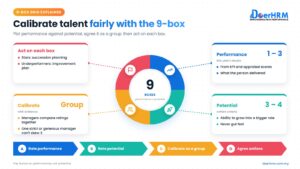
A 9 box grid is an HR talent tool that places each employee on a 3 × 3 grid using two ratings: current performance (low, moderate, high) and future potential (low, moderate, high). Each box points to a different action. Used in a calibration meeting, it makes talent decisions fairer and more consistent across managers.
Key takeaways
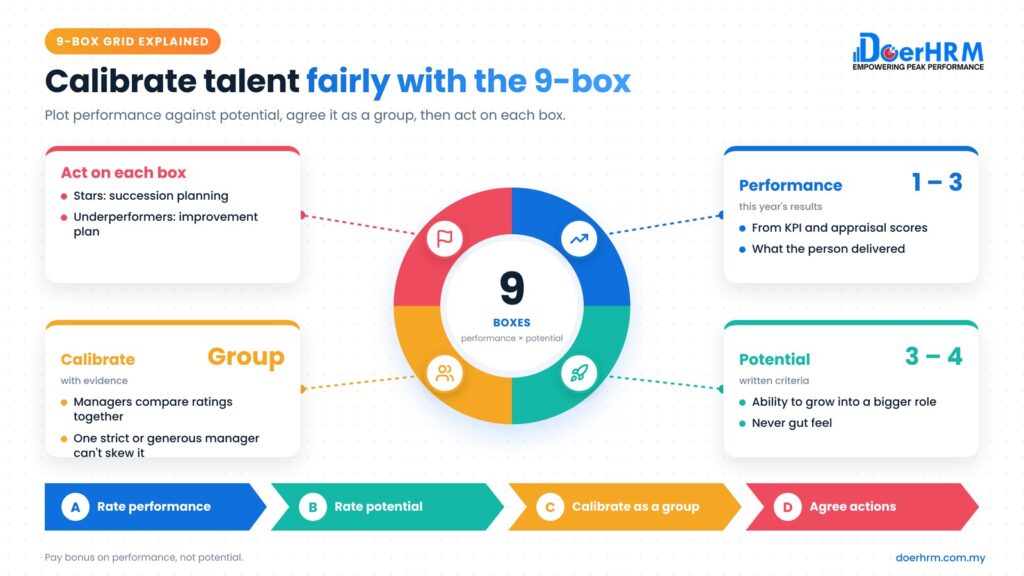
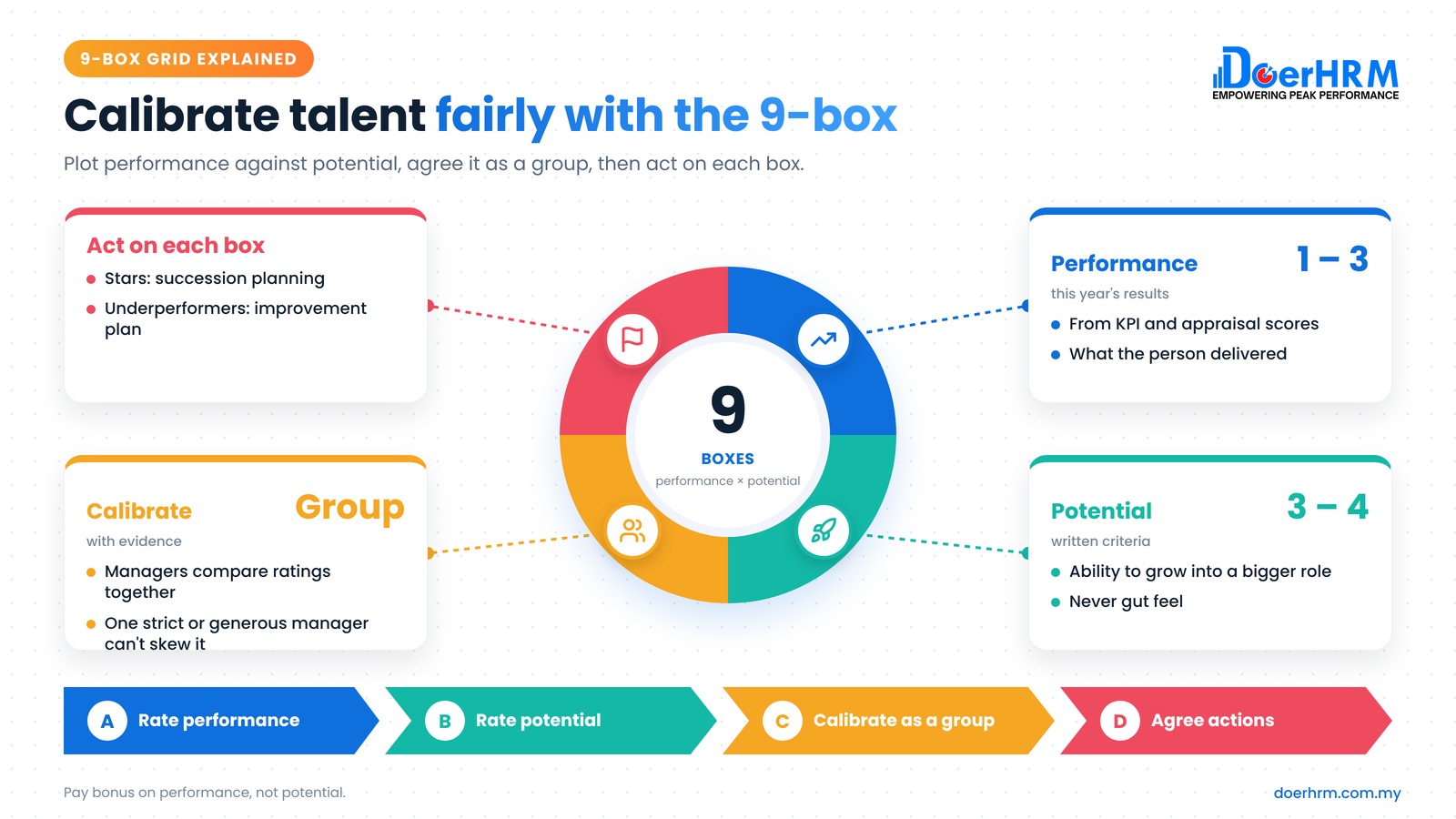
- Performance is what the person delivered this year, taken from KPI and appraisal results. Potential is their ability to grow into a bigger role.
- Each of the 9 boxes has its own action, from succession planning for Stars to improvement plans for underperformers.
- Rate potential against 3 to 4 written criteria, not gut feel.
- Calibrate as a group with evidence, so one generous or strict manager does not skew the results.
- Use the grid for development and succession. Base bonus and increments on performance, not potential.
By Ng Shone Fone, Founder and CEO of DoerHRM, with 30 years in business. Reviewed by Bernard Yong, Chief Software Engineer and Co-founder of DoerHRM.
What is a 9-box grid in HR?
A 9-box grid is a 3 × 3 matrix that plots employees by performance on one axis and potential on the other. It gives managers a shared picture of their people, so they can plan development, succession and retention together.
Most companies run it once a year, straight after the annual performance appraisal. The two axes are:
- Performance (horizontal axis): how well the person delivered this year. Use the final KPI score and appraisal rating.
- Potential (vertical axis): how likely the person is to succeed in a bigger or more complex role in the next 2 to 3 years.
It answers questions a normal appraisal does not: who could take over from the Production Manager, and who is excellent but happy where they are?
What are the 9 boxes and what should you do with each?
Each box combines one performance level with one potential level. Box names vary between companies, but the labels below are common and give you a good starting point.
| Potential ↓ / Performance → | Low performance | Moderate performance | High performance |
|---|---|---|---|
| High potential | Enigma | Growth employee | Star |
| Moderate potential | Dilemma | Core player | High performer |
| Low potential | Underperformer | Effective employee | Trusted professional |
Here is what each box usually means and what to do next:
| Box | What it usually means | What to do |
|---|---|---|
| Star (high / high) | Delivers strongly and is ready for a bigger role soon | Name as a successor, give stretch assignments and mentoring, hold a retention conversation |
| High performer (high performance / moderate potential) | Delivers strongly and is still growing | Widen their scope, develop one or two leadership skills |
| Trusted professional (high performance / low potential) | Reliable expert who is happy in the role | Recognise them, use them as trainers or subject experts, do not force a promotion |
| Growth employee (moderate performance / high potential) | Capable of more, not yet delivering fully | Coach, clarify targets, give one stretch project |
| Core player (moderate / moderate) | The steady backbone of the team | Keep roles clear, offer steady development |
| Effective employee (moderate performance / low potential) | Solid in the current role | Keep skills current, recognise reliability |
| Enigma (low performance / high potential) | Shows ability but is not delivering | Find the cause (new role, unclear goals, wrong fit), agree a short plan, consider a role change |
| Dilemma (low performance / moderate potential) | Under-delivering, outlook unclear | Set a clear improvement plan with regular check-ins and a decision date |
| Underperformer (low / low) | Not meeting the role’s needs | Use a performance improvement plan; if there is no improvement, consider redeployment or exit following a fair, documented process |
“Low potential” means low readiness for a bigger role now. It does not mean low value. Many Trusted professionals are the people your operation depends on most. Before any exit decision, check with an employment law adviser. In Malaysia, a dismissal generally needs just cause or excuse and a fair process (see our guide to handling poor performance and PIPs).
If someone has been in their role for less than about 6 months, mark them “too new to rate” rather than forcing a box.
How do you rate performance on a 9-box grid?
Use the final, calibrated KPI score and appraisal rating, and convert them into three bands. Do not re-rate performance from memory in the talent meeting.
Performance should already be settled by your KPI performance management process. The 9-box only groups it. An example banding on a 5-point scale:
| Appraisal rating | KPI score (example) | 9-box performance band |
|---|---|---|
| 1 – 2 | Below 90% | Low |
| 3 | 90 – 99% | Moderate |
| 4 – 5 | 100% and above | High |
Illustrative bands only. Use your own rating scale.
How do you rate potential fairly?
Rate potential against 3 to 4 written criteria, each scored with an example, rather than as one gut-feel judgement. Agree the criteria before the cycle starts and use the same ones in every department.
An example set of criteria, each scored 1 (low) to 3 (high):
- Learning agility: picks up new skills quickly and applies them.
- Aspiration: wants a bigger role and is willing to take on more. Ask the employee; do not guess.
- Scope: has handled wider or more complex work when given the chance.
- Influence: works well across teams and brings others along.
Add the four scores for a total between 4 and 12:
| Potential total | Potential band |
|---|---|
| 4 – 6 | Low |
| 7 – 9 | Moderate |
| 10 – 12 | High |
Example: Mei Ling, a Production Supervisor, scores 3 + 3 + 2 + 2 = 10, so her potential band is High.
Keep it fair: ask for one example per score (“she led the new packing line set-up in March”, not “she has leadership qualities”), rate behaviour rather than age or tenure, and re-rate every year.
How do you run a 9-box calibration meeting?
A calibration meeting is a session, led by HR, where managers place their people on the grid, explain their evidence and agree final positions as a group. For about 20 employees, allow 75 to 90 minutes.
- Finish the appraisal first. Performance ratings should be final before the talent meeting.
- Send pre-work. Each manager places their people on a draft grid, with one line of evidence for each potential score.
- Agree the rules. The HR facilitator restates the definitions of both axes and the potential criteria. Discussions stay confidential.
- Show the whole grid. Put every draft placement on one screen so everyone sees the overall spread.
- Start with the edges. Discuss Stars and the three low-performance boxes first. These decisions matter most.
- Challenge with evidence. For each person, the manager gives one or two examples. Peers ask, “When did they show this?” Move people where the evidence does not support the placement.
- Check the spread. If most people sit top-right, standards are probably too loose. Use a guideline, not a forced quota.
- Agree one action per person. Each action has an owner and a review date.
- Record decisions and reasons. Managers then follow up in one-to-ones.
Timing: 20 people × about 3 minutes each = 60 minutes, plus 15 to 30 minutes for the opening and wrap-up.
For one team, a spreadsheet grid works. Across several branches, it helps to keep the grid next to appraisal results. In DoerHRM, the 9-Box Matrix sits in the Appraisal module alongside HR Calibration and the Bell Curve view.
What biases affect 9-box ratings?
The most common biases are recency, halo, similar-to-me, central tendency and confusing performance with potential. Written criteria, evidence and peer challenge in calibration are the main defences.
| Bias | What it looks like | How to reduce it |
|---|---|---|
| Recency | One big win in Q4 outweighs nine average months | Look at monthly KPI results for the whole year |
| Halo or horns | One strength or weakness colours everything | Rate each axis separately, each with its own evidence |
| Similar-to-me | Managers rate people like themselves higher | Use written criteria and let peers challenge |
| Central tendency | Almost everyone lands in Core player | Ask for reasons; compare the spread across teams |
| Leniency or strictness | One manager rates everyone high, another everyone low | Compare managers side by side in calibration |
| Performance = potential | A top performer is assumed ready to lead | Score aspiration and influence separately |
| Visibility | Head office staff seen by directors are rated higher than branch or site staff | Ask for evidence and include branch managers in the meeting |
Should the 9-box grid be linked to pay?
Not directly. Base bonus and increments on performance, meaning KPI and appraisal results. Use the 9-box grid for development, succession and retention decisions.
There are three reasons:
- Potential is a forecast. Paying for it rewards what someone might do, not what they did.
- It invites inflation. If potential affects pay, managers will rate it higher.
- It weakens fairness. Equal results should earn a similar bonus.
For pay, follow your normal method, such as the one in our guide on how to calculate performance bonus. Use the grid for:
- Succession: name one or two possible successors for each key role, usually from the Star and High performer boxes.
- Development plans: stretch projects, training and mentoring matched to each box.
- Retention: regular conversations with Stars and Trusted professionals, plus non-cash rewards and recognition.
- Performance support: improvement plans for the three low-performance boxes.
Worked example: 9-box calibration for a 20-person team (hypothetical)
In this hypothetical example, calibration moved 4 people out of the Star box and gave a more realistic spread, while performance bands stayed exactly as set in the appraisal.
A manufacturing company in Selangor has a 20-person operations department led by three managers. Appraisal ratings are already final: 3 people are Low, 10 Moderate and 7 High on performance. Each manager places their staff on a draft grid.
Before calibration (managers’ drafts):
| Potential ↓ / Performance → | Low | Moderate | High | Total |
|---|---|---|---|---|
| High | 1 (Enigma) | 4 (Growth) | 6 (Star) | 11 |
| Moderate | 2 (Dilemma) | 5 (Core) | 1 (High performer) | 8 |
| Low | 0 (Underperformer) | 1 (Effective) | 0 (Trusted) | 1 |
| Total | 3 | 10 | 7 | 20 |
Eleven of 20 rated high potential is a warning sign, so the group checks each potential score against the four criteria.
What changed:
- 4 Stars moved. Two had no evidence of wider scope, so their potential totals fell to 8 (Moderate). They became High performers. Two others told their managers they want to stay technical experts. With aspiration and scope scored 1, their totals fell to 6 (Low), so they became Trusted professionals.
- 2 Growth employees moved. Their examples showed steady delivery but not readiness for more. One moved to Core player and one to Effective employee.
- 1 Dilemma moved to Underperformer. This was the second year of low results with no sign of progress.
After calibration:
| Potential ↓ / Performance → | Low | Moderate | High | Total |
|---|---|---|---|---|
| High | 1 (Enigma) | 2 (Growth) | 2 (Star) | 5 |
| Moderate | 1 (Dilemma) | 6 (Core) | 3 (High performer) | 10 |
| Low | 1 (Underperformer) | 2 (Effective) | 2 (Trusted) | 5 |
| Total | 3 | 10 | 7 | 20 |
The column totals did not change (3, 10 and 7), because performance was settled in the appraisal. Only potential was calibrated.
Agreed actions:
- The 2 Stars, Hafiz and Mei Ling, are named as possible successors for the Production Manager role, each with a mentor.
- The 3 High performers each take one cross-department project.
- The 2 Trusted professionals become in-house trainers for new operators.
- Ravi, the Enigma, joined as QC Executive 8 months ago. His manager agrees clearer targets and a 3-month check-in.
- The Dilemma and the Underperformer get improvement plans with a review in 3 months.
What are the most common 9-box mistakes?
The biggest mistakes are tying the grid to pay, rating potential without criteria, sharing labels like “Underperformer” publicly, treating a box as permanent, and skipping follow-up. A grid without agreed actions is just a chart.
Frequently asked questions
What is a 9-box grid in HR? A 9-box grid is a 3 × 3 talent matrix that plots employees by current performance and future potential. HR and managers use it to plan development, succession and retention.
What is the difference between performance and potential? Performance is what someone delivered in the current role this year. Potential is how likely they are to succeed in a bigger or more complex role in the next 2 to 3 years.
How often should you do a 9-box review? Most companies do it once a year, right after the annual appraisal. Some also do a short mid-year check for key roles and successors.
Should employees know their 9-box position? Many companies share the development actions rather than the box label. Whatever you decide, make it a written policy and apply it the same way to everyone.
Is a 9-box grid the same as a bell curve? No. A bell curve looks only at how performance ratings are spread. A 9-box grid adds a second dimension, potential, for talent decisions.
Can a small company use a 9-box grid? Yes. Even with 10 to 20 staff, it helps the owner and managers agree who to develop and who could step into key roles.
Conclusion
The 9 box grid is simple: two ratings, nine boxes, one action per person. Its value comes from fair inputs: calibrated performance results, potential rated against written criteria, and placements agreed as a group. Keep pay linked to performance; use the grid for development and succession.
Want to run your next talent review with appraisal results and the 9-box grid in one place? Book a free session with a DoerHRM expert and we’ll show you how calibration works in DoerHRM’s KPI and performance management software.
Ng Shone Fone is the Founder and CEO of DoerHRM and Group CEO of Obsnap. With 30 years in business, he helps Malaysian companies link KPIs, appraisal and talent decisions.