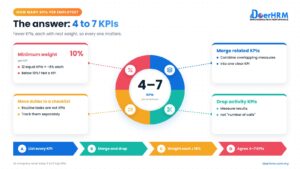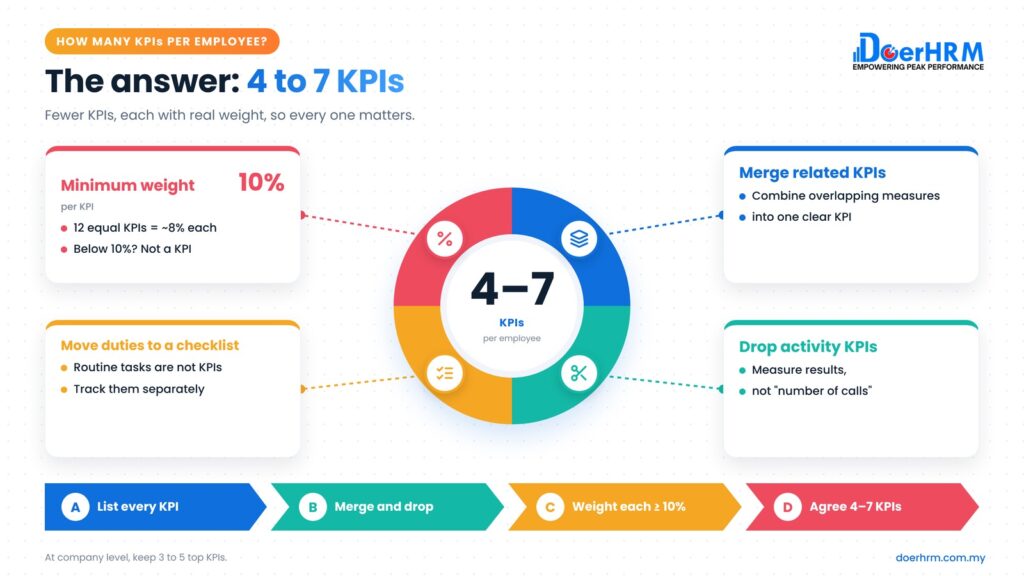
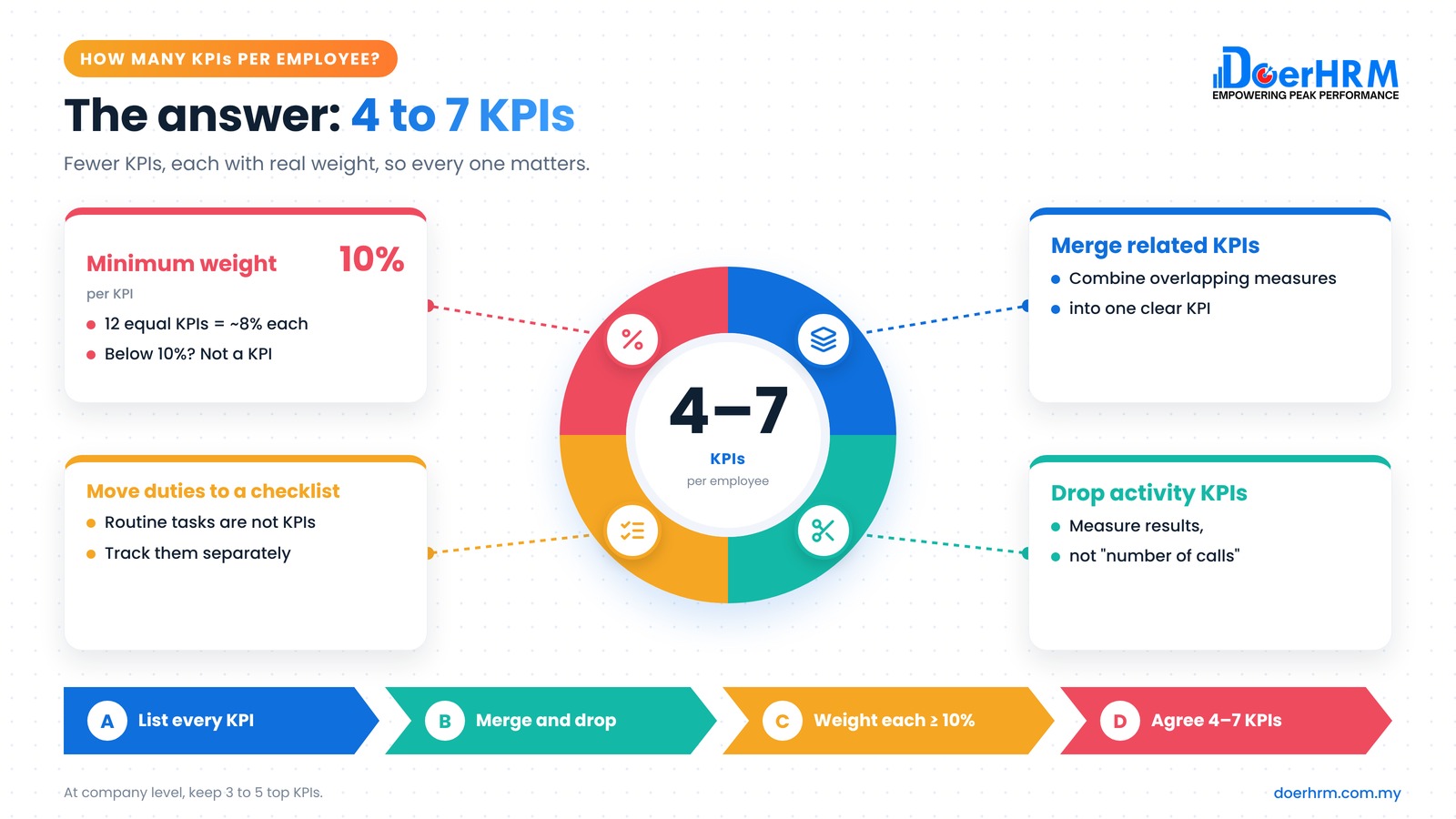
Most employees should have 4 to 7 KPIs. Fewer than 4 can leave out important parts of the job. More than 7 spreads the weight so thin that no single KPI really matters. Frontline staff sit at the lower end, managers and heads of department at the upper end, and every KPI should carry at least 10% weight.
Key takeaways
- The usual answer to how many KPIs per employee: 4 to 7.
- With 12 equally weighted KPIs, each is worth only about 8%, so missing one barely changes the score.
- Every KPI should carry at least 10% weight. If it doesn’t deserve 10%, it isn’t a KPI.
- Cut a long list by merging related KPIs, dropping activity KPIs and moving routine duties to a checklist.
- At company level, keep 3 to 5 top KPIs.
By Ng Shone Fone, Founder and CEO of DoerHRM, with 30 years in business.
How many KPIs per employee is ideal?
For most roles, 4 to 7 KPIs is ideal. That is enough to cover the results that matter, and few enough that each one carries real weight in the appraisal.
In our KPI workshops, heads of department often arrive with 10 to 15 KPIs per person. Most of them describe activities or basic duties, not results. Once these are cleaned up, the list usually comes down to 4 to 7.
The right number depends on the job:
- Simple, focused roles (for example, a production operator or accounts clerk) do well with 4 or 5.
- Broader roles (for example, a sales executive, supervisor or manager) usually need 5 to 7.
- The company scorecard should have only 3 to 5 top KPIs. These then cascade down to departments and staff.
For role-by-role examples, see our employee KPI examples.
Why do too many KPIs fail?
Too many KPIs fail because the weight is split so thinly that no single KPI changes the final score much. Employees stop focusing, managers spend more time collecting data, and the appraisal becomes a box-ticking exercise.
Weights must add up to 100%. The more KPIs you add, the less each one is worth:
| Number of KPIs | Weight each (if equal) |
|---|---|
| 4 | 25% |
| 5 | 20% |
| 7 | about 14% |
| 10 | 10% |
| 12 | about 8% |
| 15 | about 7% |
With 12 KPIs, each is worth about 8% (100 ÷ 12 = 8.3%). An employee can completely miss an important result, such as debt collection, and still score above 90%. With 5 KPIs at 20% each, the same miss costs 20 points. That is a signal both the employee and the manager will notice.
Other problems with long KPI lists:
- Lost focus. People cannot prioritise 12 things at once, so they choose the easiest ones.
- Data burden. Every KPI needs a data source and someone to update it each month.
- Weak conversations. Monthly reviews turn into reading a long list instead of solving the 2 or 3 real problems.
How many KPIs should each role level have?
Staff usually need 4 to 6 KPIs, while supervisors, managers and heads of department usually need 5 to 7. The more senior the role, the more the KPIs should measure team or department results rather than personal tasks.
| Role level | Suggested number of KPIs | What the KPIs should focus on | Example mix |
|---|---|---|---|
| Staff (clerk, operator, executive) | 4 to 6 | Own output, quality and timeliness | Accuracy, turnaround time, output, customer feedback |
| Supervisor | 5 to 7 | Team output plus people basics | Team output, quality, safety, absenteeism, training completed |
| Manager | 5 to 7 | Department results and improvement | Cost vs budget, service level, productivity, staff turnover |
| Head of department (HOD) | 5 to 7 | Department KPIs linked to company KPIs | Revenue or cost contribution, key project, talent, compliance |
These are guidelines, not rules. If a role genuinely needs 8 KPIs, check whether two of them can be merged before you accept it.
What is the minimum weight rule?
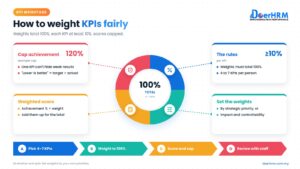
Give every KPI at least 10% weight (sometimes called weightage). If a KPI does not deserve 10% of the score, it is not important enough to be a KPI. Track it another way.
The 10% rule also limits the list naturally. With a 10% minimum, the maximum is 10 KPIs. In practice, your most important KPI will need 25% to 35%, which keeps most lists at 7 or fewer.
Items that fail the 10% test can still be managed:
- On a checklist reviewed by the supervisor (for example, “CRM updated weekly”).
- As a job expectation in the job description or SOP (for example, attendance at meetings).
- As a competency in the appraisal form (for example, teamwork or product knowledge).
For how weights flow into the final score, see our guide to KPI performance management.
How do you cut a long KPI list?
Cut a long KPI list in five steps: list everything, merge KPIs that measure the same result, drop activity KPIs, move routine duties to a checklist, then reweight to 100% with at least 10% each.
- List every KPI with its current weight. Put them in one table so you can see the whole picture.
- Merge KPIs that measure the same result. “Customer visits”, “calls per day” and “quotations sent” all feed one result: winning business. Replace them with one result KPI, such as quotation conversion rate.
- Drop activity KPIs that already drive a result KPI. If sales achievement is measured, you rarely need to also measure the number of calls.
- Move routine duties to a checklist. Reports on time, CRM updates and meeting attendance are expected, not achievements.
- Reweight to 100%. Give the biggest weight to the result that matters most, and check that no KPI is below 10%.
Then agree the final list with the employee. Our sample KPI templates calculate weighted scores for you.
Worked example: 12 KPIs trimmed to 5 (hypothetical)
Hypothetical example: Ravi, a sales executive at a Malaysian trading company, starts the year with 12 KPIs. Each is worth 5% to 20%, and important results like margin and collection carry only 5% each.
Before: 12 KPIs
| KPI | Weight |
|---|---|
| Sales target achievement | 20% |
| New customers | 10% |
| Calls per day | 10% |
| Customer visits | 10% |
| Quotations sent | 10% |
| Customer complaints | 10% |
| CRM updated | 5% |
| Debts collected within 60 days | 5% |
| Gross margin | 5% |
| Weekly report on time | 5% |
| Sales meeting attendance | 5% |
| Product training attended | 5% |
| Total | 100% |
After: 5 KPIs
| KPI | Weight | What happened to the old KPIs |
|---|---|---|
| Sales target achievement | 35% | Kept, weight increased |
| Gross margin | 20% | Kept, weight increased |
| Debts collected within 60 days | 20% | Kept, weight increased |
| New customers | 15% | Kept |
| Quotation conversion rate | 10% | Replaces calls, visits and quotations sent |
| Total | 100% |
CRM updates, weekly reports, meeting attendance and product training move to the supervisor’s monthly checklist. Customer complaints are reviewed in the monthly meeting and can return as a KPI if they become a problem.
What changes in the score? Say Ravi completes all his activity and admin items (100%), but achieves only 70% of his sales target, 60% of the margin target, 50% of the collection target, 50% of the new customer target and 80% of the conversion target. Complaints are on target.
- Before: 20 × 70% + 10 × 50% + 10 + 10 + 10 + 10 + 5 + 5 × 50% + 5 × 60% + 5 + 5 + 5 = 84.5%
- After: 35 × 70% + 20 × 60% + 20 × 50% + 15 × 50% + 10 × 80% = 24.5 + 12 + 10 + 7.5 + 8 = 62%
With 12 KPIs, weak sales results looked like a good year. With 5, the score shows the real picture, and the review can focus on margin and collection. For more sales KPI ideas, see our sales KPI examples.
Frequently asked questions
How many KPIs should an employee have? Most employees should have 4 to 7 KPIs. Staff in focused roles need 4 to 6, while supervisors, managers and HODs usually need 5 to 7.
What is the minimum weight for a KPI? A good rule is at least 10%. If a KPI is not worth 10% of the score, track it on a checklist or as a competency instead.
Is 10 KPIs too many for one employee? Usually, yes. With 10 equally weighted KPIs, each is worth only 10%, and focus is lost. Merge related KPIs and move routine duties to a checklist.
How many KPIs should a company have? At company level, 3 to 5 top KPIs is enough. These then cascade to departments and individual employees.
Should every employee in the same role have the same KPIs? Usually, yes, so results can be compared fairly. Targets can differ, for example by territory or experience level.
Can an employee have only 2 or 3 KPIs? It is possible for very simple roles, but each KPI then carries a lot of weight. Most roles need at least 4 to cover output, quality and timeliness.
Conclusion
Aim for 4 to 7 KPIs per employee, give each at least 10% weight, and make sure the biggest weight sits on the result that matters most. If your current lists run to 10 or more, merge, drop activity KPIs and move routine duties to a checklist. Shorter lists lead to clearer focus and more honest appraisals.
Want your heads of department to trim and rebuild KPIs like this for every role? Request a customised KPI workshop proposal for your management team.
Ng Shone Fone is the Founder and CEO of DoerHRM and Group CEO of Obsnap. With 30 years in business, he is a Certified HRD Corp Trainer who helps Malaysian companies set clear, fair KPIs.