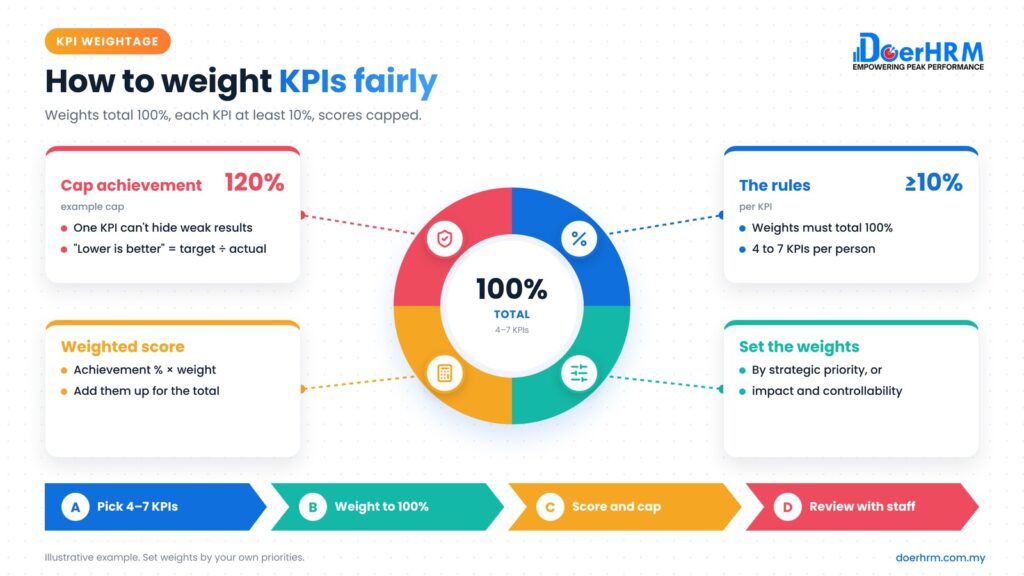
KPI weightage is the percentage of importance given to each KPI, with all weights adding up to 100%. To weight KPIs in an appraisal, choose 4 to 7 KPIs, give each at least 10%, set higher weights for the KPIs that matter most to the business, then multiply each KPI’s achievement by its weight and add the results.
Key takeaways
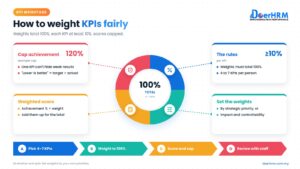
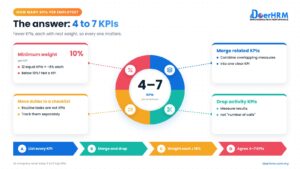
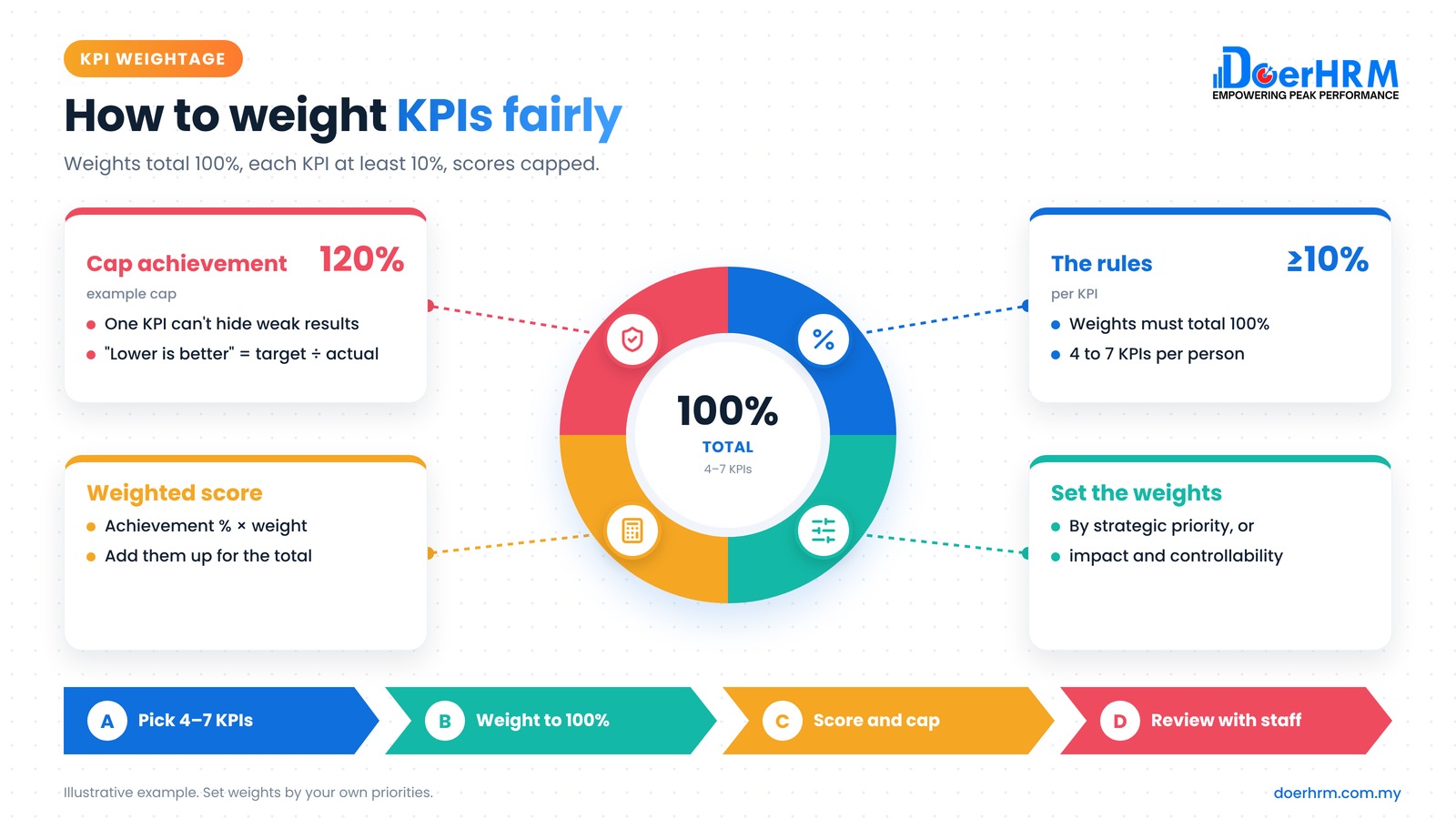
- Weights must total 100%. Keep each KPI at 10% or more, with 4 to 7 KPIs per person.
- Set weights by strategic priority, by impact and controllability, or start equal and adjust.
- Weighted score = achievement % × weight. Add them up for the overall KPI score.
- Cap achievement per KPI (for example, at 120%) so one KPI cannot hide weak results elsewhere.
- Score “lower is better” KPIs with an inverted formula, such as target ÷ actual.
By Ng Shone Fone, Founder and CEO of DoerHRM, with 30 years in business.
Important: the weights, caps and targets in this article are examples to help you design your own scorecard. Set your own based on your business priorities and appraisal policy.
What are the rules for KPI weightage?
Four simple rules cover most cases: total 100%, at least 10% per KPI, 4 to 7 KPIs per person, and no single KPI so heavy that it decides the whole result.
| Rule | Why it matters |
|---|---|
| Weights add up to 100% | The overall score then reads as a simple percentage |
| Each KPI is at least about 10% | A KPI below 10% barely moves the score, so people ignore it |
| 4 to 7 KPIs per person | Fewer misses key results; more spreads focus too thin |
| No single KPI above about 40% | One bad month on one KPI should not sink the whole appraisal |
More than 7 KPIs usually means some are tasks, not results. See our employee KPI examples for typical KPI sets by role.
How do you decide the weight of each KPI?
Use one of three methods: weight by strategic priority, weight by impact and controllability, or start with equal weights and adjust. Most companies use the first and check it against the second.
Method 1: Strategic priority
Sort each KPI into a tier and give each tier a weight range (example ranges):
- Critical (drives this year’s company goal): 25 – 40%
- Important (protects quality, cost or customers): 15 – 25%
- Supporting (builds capability or compliance): 10 – 15%
Method 2: Impact × controllability
Score each KPI from 1 to 3 on two questions: how much does it affect results (impact), and how much can this person control it (controllability)? Multiply the two scores, divide each product by the total, then round to the nearest 5%.
Example: Sales Executive
| KPI | Impact (1–3) | Control (1–3) | Product | Raw weight | Rounded weight |
|---|---|---|---|---|---|
| Sales revenue vs target | 3 | 2 | 6 | 27.3% | 25% |
| Gross profit margin | 3 | 2 | 6 | 27.3% | 25% |
| Payments collected within 60 days | 2 | 2 | 4 | 18.2% | 20% |
| New customer accounts | 3 | 1 | 3 | 13.6% | 15% |
| Quotation turnaround time | 1 | 3 | 3 | 13.6% | 15% |
| Total | 22 | 100% | 100% |
This stops heavy weights on KPIs a person cannot influence. After rounding, check the total is still 100%.
Method 3: Equal weights as a starting point
With 5 KPIs, start at 20% each. Move weight in 5% steps towards the KPIs that matter most, keeping every KPI at 10% or more. This suits a first appraisal cycle.
How do you calculate a weighted KPI score?
Work out each KPI’s achievement %, apply any cap, multiply by the weight, then add the results.
- Achievement %: actual ÷ target × 100 for “higher is better” KPIs.
- Invert “lower is better” KPIs: use target ÷ actual × 100 (see below).
- Apply the cap: for example, any result above 120% counts as 120%.
- Weighted score: capped achievement × weight.
- Add up the weighted scores for the overall KPI score.
You can do this in our free Staff KPI Scorecard template, which calculates the weighted score for you.
How do you score “lower is better” KPIs?
For KPIs where a lower number is better, such as response time, defects or complaints, invert the formula so that beating the target gives more than 100%. The most common formula is target ÷ actual × 100.
Example: target first-response time is 2.0 hours; actual is 2.5 hours.
| Formula | Calculation | Achievement |
|---|---|---|
| Target ÷ actual | 2.0 ÷ 2.5 | 80% |
| (2 × target − actual) ÷ target | (4.0 − 2.5) ÷ 2.0 | 75% |
The second formula drops faster. Choose one, write it in the KPI definition and use it for every similar KPI. If the actual can be zero, target ÷ actual cannot be calculated, so let the cap decide the score.
Why cap KPI achievement, for example at 120%?
A cap stops one outstanding KPI from hiding poor results on the others. Without a cap, a 200% result on a 30% KPI adds 60 points, enough to cover several misses.
Caps of 110% to 150% per KPI, with a floor of 0%, are common choices. Apply the same rule to everyone and write it in the appraisal policy.
Worked example: a weighted KPI scorecard (hypothetical)
In this hypothetical example, Hafiz, a Customer Service Supervisor, scores 102.0% on his KPIs after a 120% cap. His weights were set by strategic priority (Method 1).
| KPI | Direction | Weight | Target | Actual | Achievement | Capped (max 120%) | Weighted score |
|---|---|---|---|---|---|---|---|
| Customer satisfaction score (out of 5) | Higher | 30% | 4.0 | 4.2 | 105% | 105% | 31.5% |
| Average first-response time (hours) | Lower | 25% | 2.0 | 2.5 | 80% | 80% | 20.0% |
| Complaints resolved within 3 working days | Higher | 20% | 90% | 99% | 110% | 110% | 22.0% |
| Quality audit score | Higher | 15% | 80% | 88% | 110% | 110% | 16.5% |
| Repeat complaints per month | Lower | 10% | 10 | 8 | 125% | 120% | 12.0% |
| Total | 100% | 102.0% |
For example, repeat complaints (lower is better): 10 ÷ 8 = 125%, capped at 120%; 120% × 10% = 12.0%. Without the cap, the total would be 102.5%.
In DoerHRM, each KPI is set as higher or lower is better when it is created, and the scorecard calculates each weighted score as weight × achievement ÷ 100.
How do you split KPIs and competencies in an appraisal?
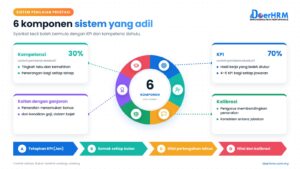
Many appraisals combine a KPI score (results) with a competency score (behaviours and skills). A 70/30 split is a common example, not a rule.
Continuing the example, Hafiz scores 4.0 out of 5 on competencies, which is 80%.
| Part | Score | Weight | Weighted |
|---|---|---|---|
| KPI score | 102.0% | 70% | 71.4% |
| Competency score | 80.0% | 30% | 24.0% |
| Overall appraisal score | 100% | 95.4% |
Some companies use 60/40 for junior roles or 80/20 for sales. Keep the split the same within each role group. In DoerHRM’s performance appraisal form templates, the weights must total 100% before a form can be used.
The overall score then feeds rating, bonus and increment decisions. See how to calculate performance bonus for the next step.
What are the common KPI weightage mistakes?
The most common mistakes are too many small weights, weighting by effort instead of importance, and changing weights mid-year without agreement.
- Ten KPIs at 5% to 15% each. Nothing stands out, so nothing gets focus.
- Weighting by effort, not importance. Routine tasks take time but may not drive results.
- Heavy weight on KPIs the person cannot control. It feels unfair.
- Forgetting to invert “lower is better” KPIs. More complaints should never score higher.
- Changing weights mid-year. Agree weights at the start of the cycle; change them only with the employee’s agreement.
Frequently asked questions
How do you weight KPIs in an appraisal? Choose 4 to 7 KPIs, give each a weight of at least 10% so the total is 100%, and set higher weights for KPIs that matter most. Multiply each KPI’s achievement by its weight and add the results.
What is KPI weightage? KPI weightage is the percentage of importance given to each KPI in a scorecard. All weights add up to 100%, so the weighted total shows overall performance as a single percentage.
How many KPIs should an employee have? Usually 4 to 7. Fewer may miss important results; more spreads focus too thin and pushes weights below 10%.
How do you score a KPI where lower is better? Invert the formula. The most common version is target ÷ actual × 100, so beating the target gives more than 100%.
Should every employee have the same KPI weightage? No. Weights should reflect each role’s priorities. People in the same role should usually share the same weights, so results stay comparable.
Conclusion
Good KPI weightage is simple: 4 to 7 KPIs, at least 10% each, totalling 100%, with the most weight on what matters most. Invert “lower is better” KPIs, cap achievement, agree a clear KPI vs competency split, and check the arithmetic before sign-off.
Want weighted scores calculated automatically from actual KPI results? Book a free session with a DoerHRM expert and we’ll show you how a weighted KPI scorecard flows into appraisal.
Ng Shone Fone is the Founder and CEO of DoerHRM and Group CEO of Obsnap. With 30 years in business, he is a Certified HRD Corp Trainer who helps Malaysian companies set clear KPIs and fair appraisals.