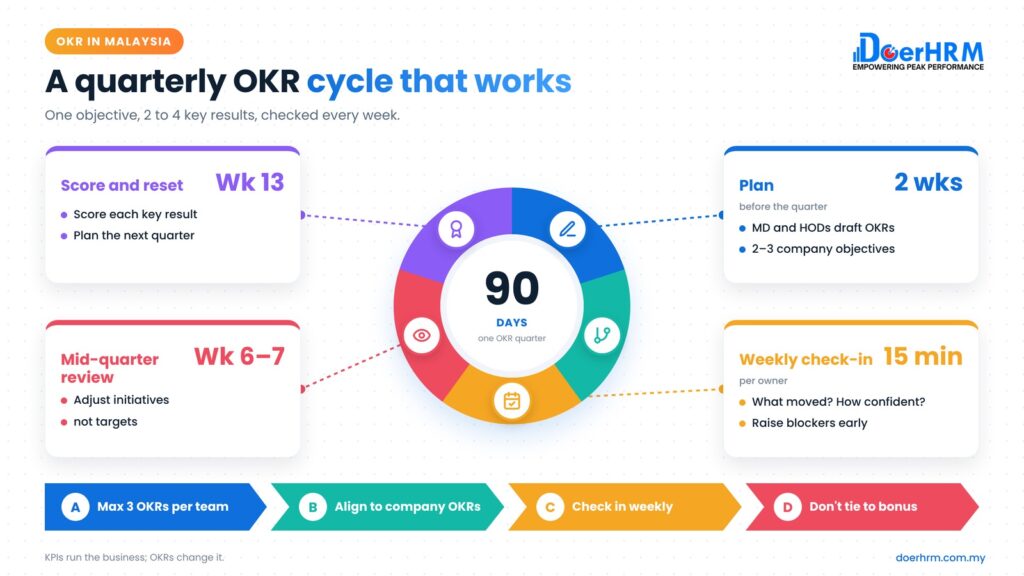
Malaysian companies use OKRs (Objectives and Key Results) to drive a few important changes each quarter, while KPIs keep the day-to-day business running. A typical SME sets 2 to 3 company objectives, links each team’s OKRs to them, checks progress weekly, scores results at quarter end and keeps OKRs separate from bonus.
Key takeaways
- An OKR is one clear objective plus 2 to 4 measurable key results, usually for one quarter.
- KPIs run the business; OKRs change it. Most Malaysian SMEs need both.
- Start small: 2 to 3 company objectives and no more than 3 OKRs per team.
- Check in weekly, review mid-quarter, then score and reset every quarter.
- Do not link OKR scores directly to bonus. Reward through KPIs and appraisal instead.
By Ng Shone Fone, Founder and CEO of DoerHRM, with 30 years in business.
This OKR Malaysia guide is for managers who are new to OKRs. If you need the basics first, read our overview of what OKR is. Here we focus on practice: how local companies actually set OKRs, track them each week and avoid the mistakes we see most often in our workshops with Malaysian management teams.
What is an OKR, in plain terms?
An OKR is a short goal statement (the objective) with 2 to 4 numbers that prove you achieved it (the key results). The objective says where you want to go. The key results say how you will know you got there.
Every key result needs a starting number, a target and a deadline.
| Part | What it is | Example |
|---|---|---|
| Objective | Qualitative, short, motivating | “Make our delivery something customers never have to chase” |
| Key result | Measurable outcome, from X to Y | “On-time delivery from 85% to 95% by 31 March” |
| Initiative | Work you will do to move the key result | “Introduce a daily dispatch meeting” |
Initiatives are not key results. This one distinction fixes most weak OKRs.
How do Malaysian companies use OKRs?
Most Malaysian companies use OKRs for a small number of change priorities, such as entering a new market, digitalising a process or fixing a quality problem. The MD and heads of department set 2 to 3 company OKRs each quarter, teams link their own OKRs to them, and progress is reviewed weekly.
In our experience, the companies that get value from OKRs follow a similar pattern:
- Annual direction first. The owner or board sets 3 to 5 priorities for the year, often from a strategy session or SWOT review.
- Quarterly company OKRs. Two or three of those priorities become this quarter’s company OKRs.
- Team OKRs that link upwards. Each department sets 1 to 3 OKRs that support a company OKR. Not every team needs one every quarter.
- Weekly check-ins. Short updates on progress and confidence, usually in an existing management meeting.
- KPIs continue as normal. Sales, cost, quality and service KPIs are still tracked monthly.
There are also some local realities to plan for. Many Malaysian SMEs are owner-led, so OKRs can easily become the boss’s to-do list unless teams are asked for their own ideas. Festive seasons such as Chinese New Year, Hari Raya and Deepavali can take a large bite out of a quarter’s working days, depending on your industry. Set fewer, smaller OKRs for those quarters rather than missing them.
What do OKRs look like in Malaysian SMEs?
Good OKRs look different in every industry, but they share one feature: each key result measures a change in an outcome, not a list of tasks. Here are five hypothetical examples for typical Malaysian organisation types.
All five examples are illustrative. Use them as a pattern, not as targets.
1. Manufacturer (for example, a metal parts maker in Shah Alam) Objective: Become the supplier our customers never have to chase on quality. – KR1: Reduce defect rate from 3.0% to 1.5% – KR2: Increase overall equipment effectiveness (OEE) on Line 2 from 60% to 70% – KR3: Cut customer returns from 12 to 6 per quarter
2. Trading company or distributor (for example, a building materials distributor in Klang) Objective: Build a profitable foothold in Johor. – KR1: Sign 25 new active dealers in Johor – KR2: Grow Johor monthly sales from RM150,000 to RM250,000 – KR3: Keep debts over 90 days below 5% of Johor sales
3. Professional services (for example, an accounting and tax firm) Objective: Make our firm the easiest to work with during tax season. – KR1: Cut average reply time to client queries from 3 working days to 1 – KR2: Collect complete documents from 90% of clients by the internal deadline (from 60%) – KR3: Raise client satisfaction from 4.0 to 4.5 out of 5
4. Retail (for example, a bakery chain with 8 outlets) Objective: Turn first-time buyers into regulars. – KR1: Grow active members from 4,000 to 6,000 – KR2: Raise the repeat purchase rate of members from 30% to 40% – KR3: Increase average basket size from RM38 to RM45
5. GLC-style or larger company department (for example, a procurement department) Objective: Make procurement faster without losing control. – KR1: Cut purchase requisition to purchase order time from 21 days to 10 – KR2: Increase purchase orders raised through the e-procurement system from 40% to 90% – KR3: Raise internal user satisfaction with procurement from 3.2 to 4.0 out of 5
Notice that none of the key results say “launch”, “train” or “hold a meeting”. Those are initiatives. For more on choosing the right numbers, see our guide to OKR strategy execution.
How do OKRs and KPIs work together?
KPIs run the business; OKRs change it. KPIs measure the ongoing health of the business every month. OKRs focus effort for one quarter on the few things that must improve. When a KPI goes off track and needs a real fix, it often becomes an OKR.
| KPIs | OKRs | |
|---|---|---|
| Purpose | Keep the business running well | Change or improve something important |
| Time frame | Ongoing, reviewed monthly | Usually one quarter |
| Target | Realistic, expected to be met | Stretch, 60–70% achievement is often good |
| How many | 4 to 7 per employee | 1 to 3 per team |
| Link to pay | Usually part of appraisal and bonus | Kept separate from bonus |
| Example | On-time delivery at 95% or above | On-time delivery from 85% to 95% this quarter |
Take the manufacturer above. On-time delivery is a permanent KPI. If it falls to 85%, management makes it an OKR for one quarter, with a focused team and weekly check-ins. Once it is back at 95%, it returns to being a normal KPI and the team moves on to the next priority.
This is why OKRs without KPIs rarely work well in SMEs. For a fuller comparison, read the difference between OKR and KPI in performance appraisal. If your KPIs themselves are weak, fix those first; our KPI training covers how to set them.
What does a quarterly OKR cadence look like?
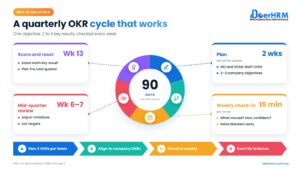
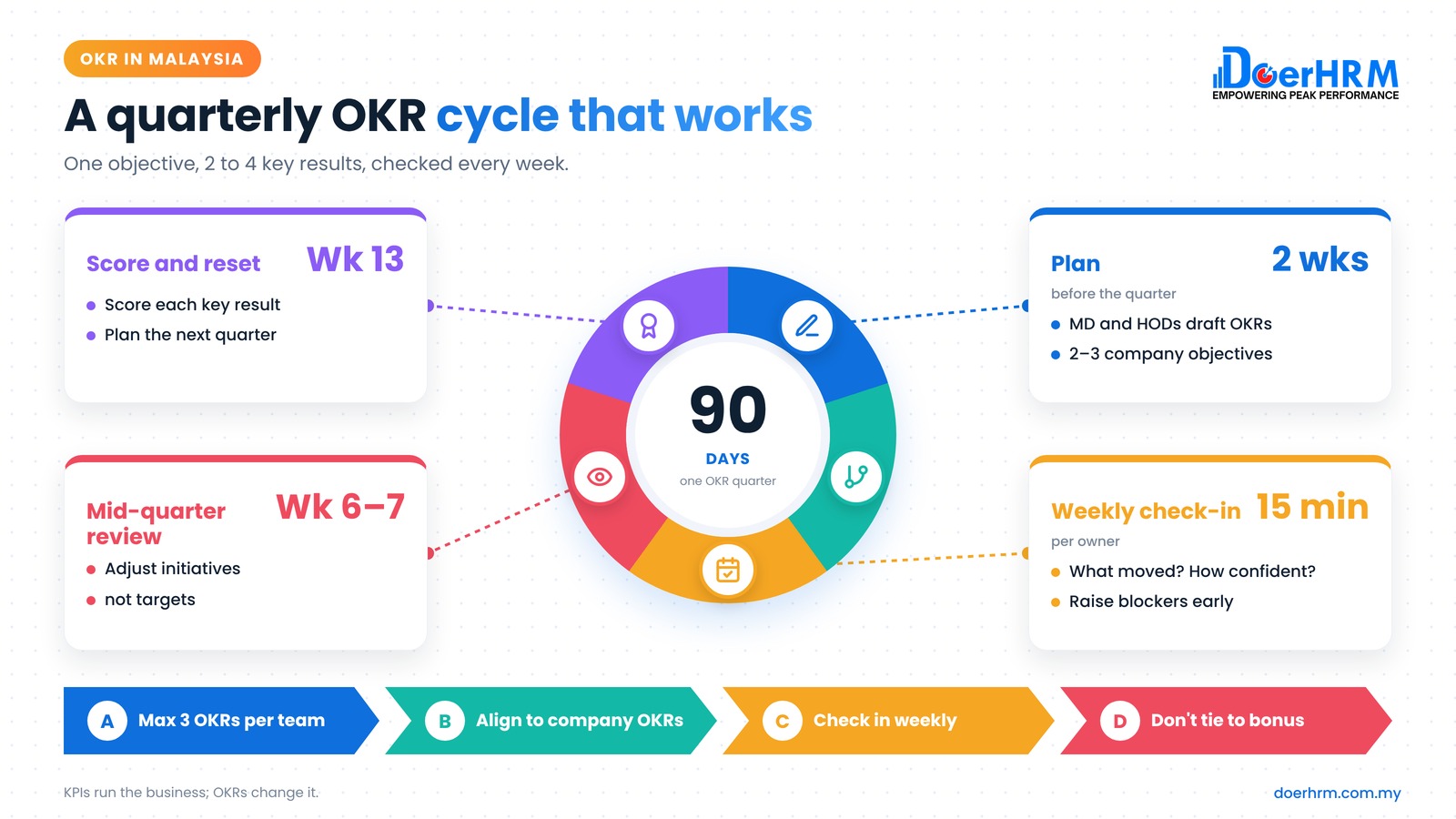
A quarterly OKR cycle has five parts: plan before the quarter starts, align in week 1, check in every week, review in the middle of the quarter, and score and reflect in the final week.
| When | What happens | Who | Time needed |
|---|---|---|---|
| 2 weeks before the quarter | Draft company OKRs and team OKRs | MD and HODs | Half-day workshop |
| Week 1 | Align team OKRs to company OKRs and publish them | HODs and teams | 1 to 2 hours per team |
| Every week | Update progress and confidence level, raise blockers | Each OKR owner | 15 minutes |
| Week 6 or 7 | Mid-quarter review: adjust initiatives, not targets | MD and HODs | 1 to 2 hours |
| Week 13 | Score each key result, discuss lessons, plan next quarter | Everyone involved | Half-day |
The weekly check-in is where OKRs succeed or fail. Keep it short. Each owner answers three questions: what moved, how confident are we (for example, on a scale of 1 to 10), and what is blocking us?
Alignment matters as much as the check-in. Every team OKR should support a company OKR, and the MD should be able to see any OKR that does not link to anything.
In DoerHRM, the OKR Strategy Map shows this alignment from the company’s ultimate goal down to departments and individuals, and flags “orphan” OKRs that are not linked to anything.
How do you score OKRs at the end of a quarter?
Score each key result from 0.0 to 1.0 based on how far it moved from the starting point towards the target, then average the key results to score the objective. On a stretch OKR, many practitioners treat 0.6 to 0.7 as a good result.
Formula: progress = (actual − starting value) ÷ (target − starting value)
Worked example (hypothetical): the manufacturer’s quality OKR at the end of Q1
| Key result | Start | Target | Actual | Calculation | Score |
|---|---|---|---|---|---|
| Defect rate | 3.0% | 1.5% | 2.1% | (3.0 − 2.1) ÷ (3.0 − 1.5) = 0.9 ÷ 1.5 | 0.6 |
| OEE on Line 2 | 60% | 70% | 67% | (67 − 60) ÷ (70 − 60) = 7 ÷ 10 | 0.7 |
| Customer returns | 12 | 6 | 9 | (12 − 9) ÷ (12 − 6) = 3 ÷ 6 | 0.5 |
| Objective score | (0.6 + 0.7 + 0.5) ÷ 3 | 0.6 |
A score of 0.6 means real progress on a stretch goal. The useful question at quarter end is not “did we hit 1.0?” but “what did we learn, and does this objective continue next quarter?” Here, customer returns moved least, so the team might keep the objective and focus Q2 initiatives on returns.
Should OKRs be linked to bonus?
No, not directly. When OKR scores decide bonus, people set safe targets they know they can hit, and OKRs stop driving real change. Keep bonus linked to KPIs and the appraisal rating, and recognise OKR effort in other ways.
Malaysian business owners often ask this, because they are used to linking every target to pay. A practical approach:
- Bonus and increment come from KPI results and the overall appraisal rating, as explained in our guide on how to calculate performance bonus.
- OKR contribution can be discussed in the appraisal as evidence of initiative, teamwork and problem-solving, but not as a formula.
- Recognition for good OKR work can be immediate and public, for example in the monthly town hall.
If an OKR becomes so important that you want to pay for it, it is probably a KPI. Move it into the KPI scorecard with a realistic target.
What mistakes do Malaysian teams make with OKRs?
The four most common mistakes are too many OKRs, tasks written as key results, OKRs set only from the top, and no regular check-ins. Each one has a simple fix.
| Mistake | What it looks like | Fix |
|---|---|---|
| Too many OKRs | Every department has 5 objectives and 20 key results | Maximum 3 company objectives and 1 to 3 per team |
| Tasks as key results | “Launch new website”, “Train 10 staff” | Ask “so that what changes?” and measure that |
| Top-down only | The MD writes every team’s OKRs | MD sets company OKRs; teams propose their own and agree them |
| No check-ins | OKRs set in January, reviewed in December | 15-minute weekly check-in in an existing meeting |
Here is the “task as key result” fix in action. “Train 10 sales staff on the new product” is a task. Ask “so that what changes?” The answer might be “so that they can sell it”. The key result then becomes “Sales of the new product reach RM80,000 this quarter”. Training stays, as an initiative.
How do you roll out OKRs in 90 days?
Start with one quarter as a pilot: prepare leaders in the first 2 weeks, set and align OKRs by day 30, run weekly check-ins until day 75, then score, review and decide how to scale in the last 2 weeks.
- Days 1 to 7: Agree why you are using OKRs. The MD and HODs agree the 2 or 3 changes the company most needs this year. Write them down in one page.
- Days 8 to 14: Train the leadership team. Teach the difference between objectives, key results, initiatives and KPIs. Practise rewriting weak OKRs.
- Days 15 to 30: Set company and pilot team OKRs. Set 2 to 3 company OKRs. Choose 2 or 3 pilot departments to set their own linked OKRs. Publish them so everyone can see them.
- Days 31 to 45: Start weekly check-ins. Add a 15-minute OKR slot to an existing weekly meeting. Track progress and confidence for every key result.
- Days 46 to 60: Hold the mid-quarter review. Look at confidence levels. Change initiatives that are not working, but keep the targets.
- Days 61 to 75: Keep the rhythm and coach owners. HODs coach OKR owners whose confidence is falling. Remove blockers quickly.
- Days 76 to 90: Score, reflect and decide. Score each key result, hold a retrospective, and decide whether to extend OKRs to more teams next quarter. ## Frequently asked questions
How do Malaysian companies use OKRs? Most use OKRs for 2 to 3 change priorities each quarter, such as a new market, a digital process or a quality fix. Teams link their OKRs to company OKRs, check in weekly and keep KPIs for day-to-day performance.
What is the difference between OKR and KPI? KPIs measure the ongoing health of the business and are usually linked to appraisal. OKRs are short-term stretch goals that drive change for one quarter. KPIs run the business; OKRs change it.
How many OKRs should a team have? One to three objectives per team, each with 2 to 4 key results. At company level, 2 to 3 objectives a quarter is enough for most SMEs.
Are OKRs suitable for SMEs in Malaysia? Yes, if you keep them simple. Start with one pilot quarter, a few company OKRs and weekly check-ins. Make sure your KPIs are in place first.
Should OKRs be linked to bonus? Not directly. Linking OKR scores to bonus encourages safe targets. Keep bonus linked to KPIs and appraisal ratings, and recognise OKR contribution separately.
How often should OKRs be reviewed? Check progress weekly in a short meeting, hold a mid-quarter review, and score and reset at the end of each quarter.
Conclusion
OKRs work in Malaysian companies when they stay focused and regular: a few company priorities, team OKRs that link to them, weekly check-ins and an honest score each quarter. Keep KPIs for running the business, keep bonus away from OKR scores, and give your managers one full quarter to learn the rhythm before you scale.
Want your management team to agree 2 or 3 clear priorities and turn them into OKRs that teams actually track? Talk to us about OKR coaching for your management team.
Ng Shone Fone is the Founder and CEO of DoerHRM and Group CEO of Obsnap. With 30 years in business, he is a Certified HRD Corp Trainer who helps Malaysian managers turn strategy into clear KPIs, OKRs and results.