A lagging KPI measures a result after it has happened, such as monthly sales, profit or staff turnover. A leading KPI measures an activity or condition that predicts that result, such as quotation value sent or overdue customer complaints. In leading vs lagging KPI terms, lagging KPIs confirm the outcome and leading KPIs warn you in time to act.
Key takeaways
- A lagging KPI tells you what already happened. You cannot change it, only learn from it.
- A leading KPI tells you what is likely to happen next, while there is still time to act.
- Good scorecards pair them: every important lagging KPI should have at least one leading KPI that drives it.
- Weight lagging KPIs more heavily in appraisal, because results are what the company needs.
- Test a leading KPI by asking: “If this number drops this month, will the result drop next month?”
By Ng Shone Fone, Founder and CEO of DoerHRM, with 30 years in business.
What is a lagging KPI?
A lagging KPI is a measure of a final result, recorded after the period has ended. Sales revenue, net profit, customer churn and staff turnover are lagging KPIs. They are easy to measure and important, but by the time you see them, the result is already fixed.
Most company scorecards are built on lagging KPIs, and that is fine. Shareholders, bankers and the board judge the business on results. If you are new to KPIs, our KPI guide explains the basics first.
The problem is timing. If October sales are 15% below target, you only find out in early November, when October cannot be saved. A KPI is usually lagging if it is reported at period end, sums up many earlier actions, and cannot be changed once the period closes.
What is a leading KPI?
A leading KPI measures an activity, input or early condition that predicts a future result. Quotation value sent, sales pipeline value, on-time preventive maintenance and training completion are leading KPIs. They move before the result moves, so they give managers time to act.
Leading KPIs are usually within the employee’s direct control. A salesperson cannot force a customer to buy, but they can send more qualified quotations. A good leading KPI predicts the result, can be influenced by its owner, and is measured often enough (weekly or monthly) to show a problem early.
What is the difference between leading and lagging KPIs?
The main difference is timing and control. Lagging KPIs measure results after the event and are harder to influence directly. Leading KPIs measure the drivers before the result and are easier to act on.
| Lagging KPI | Leading KPI | |
|---|---|---|
| What it measures | Results, outcomes | Activities, inputs, early conditions |
| When you see it | After the period ends | During the period, before the result |
| Control | Indirect: many factors affect it | More direct: the owner can act on it |
| How easy to measure | Usually easy (from accounts, HR records) | Often needs a tracking habit (CRM, logbook) |
| Main use | Judge performance, report to management | Steer performance, coach the team |
| Risk if used alone | You learn too late | You reward busy work that does not produce results |
Neither type is “better”. You need both. The output vs outcome distinction works the same way; see our article on the difference between output and outcome.
What are examples of leading and lagging KPIs by department?
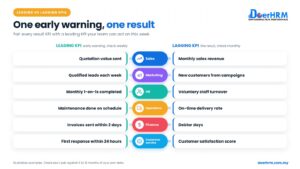
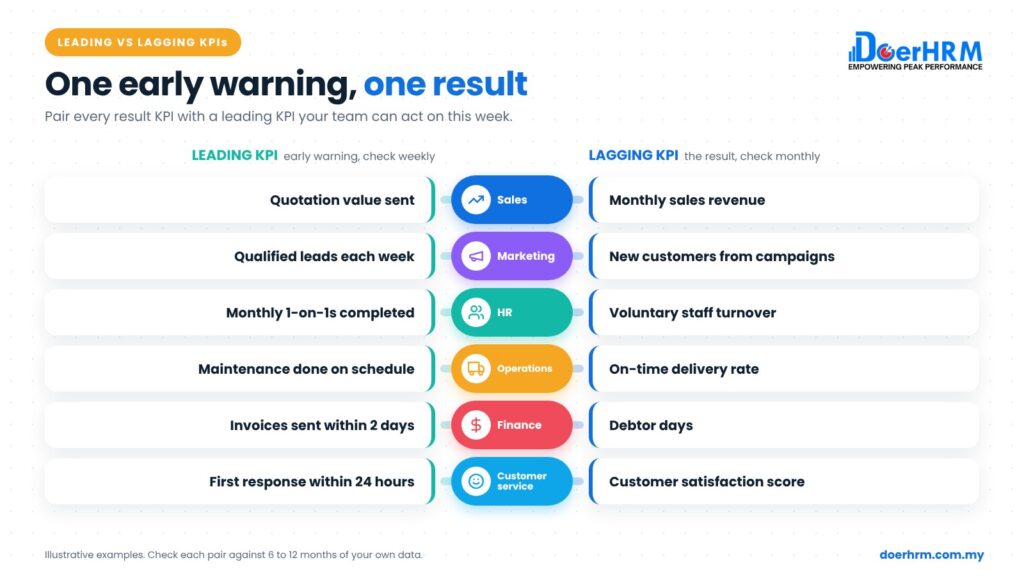
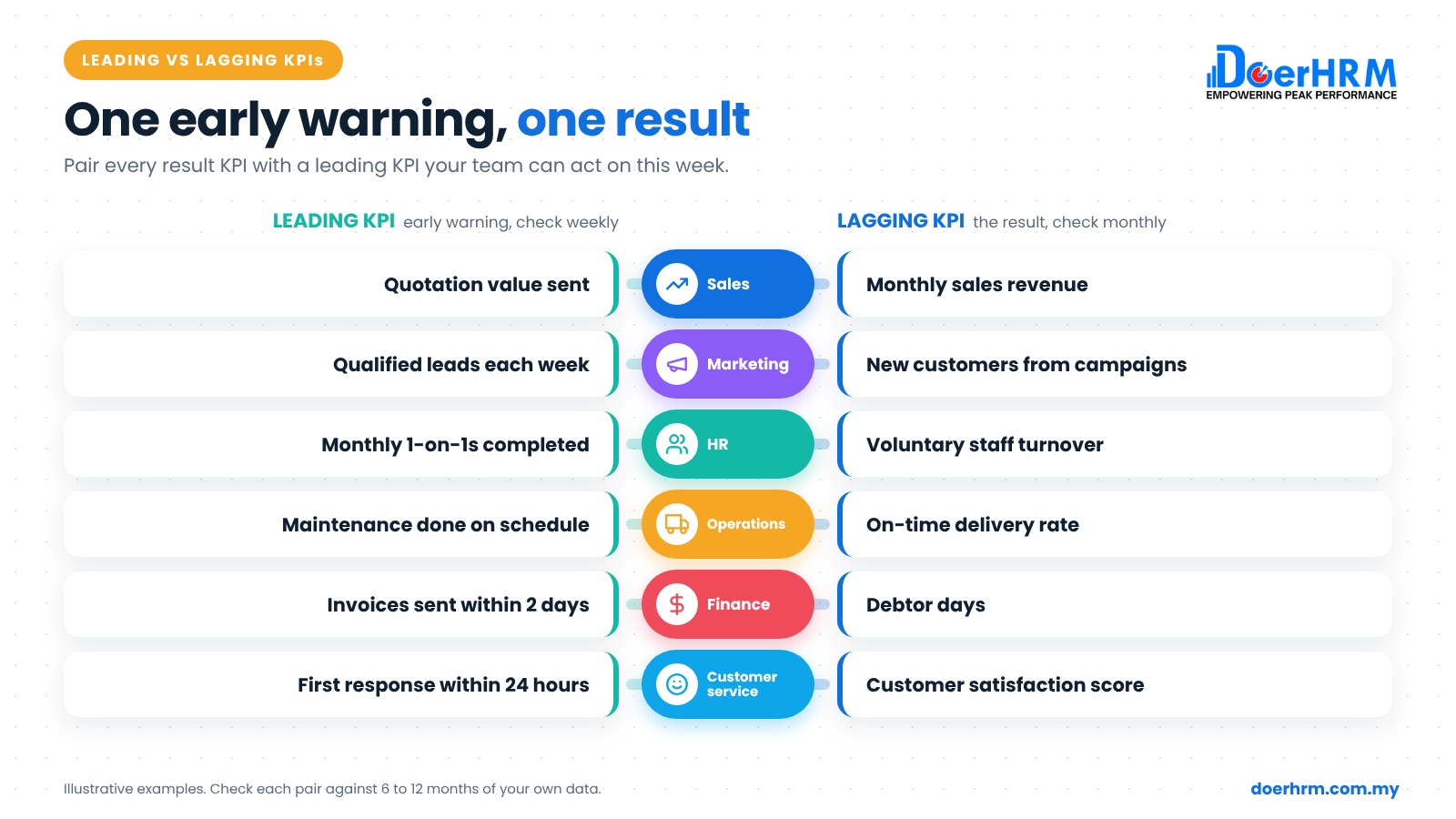
Every department can pair one lagging result with one leading driver. The table below gives one example of each for six common departments in Malaysian companies.
| Department | Lagging KPI (result) | Leading KPI (driver) |
|---|---|---|
| Sales | Monthly sales revenue (RM) vs target | Value of qualified quotations sent this month (RM) |
| Marketing | Number of new customers from marketing campaigns | Number of qualified leads passed to sales each week |
| HR | Voluntary staff turnover rate (12 months) | % of staff with a completed monthly 1-on-1 with their manager |
| Operations | On-time delivery rate to customers | % of preventive maintenance completed on schedule |
| Finance | Debtor days (average days to collect payment) | % of invoices sent within 2 working days of delivery |
| Customer service | Customer satisfaction score from surveys | % of complaints given a first response within 24 hours |
These are illustrations, not targets. Choose drivers that you have seen move your own results. For full role-by-role lists, see our employee KPI examples, and for HR in particular, our HR KPI guide.
Worked example: which number could have warned you last month? (hypothetical)
Hypothetical example: Mei Ling is the sales manager of a hardware distributor in Penang. Her October sales came in 15% below target. Her September quotation value, a leading KPI, showed the same gap a month earlier.
The facts (all hypothetical):
- Monthly sales target: RM400,000
- From her past records, about 25% of the value quoted in one month turns into orders the following month.
- So to reach RM400,000 in October, the team needed RM1,600,000 of quotations in September (RM1,600,000 x 25% = RM400,000).
What happened:
| Month | KPI | Target | Actual | Achievement |
|---|---|---|---|---|
| September | Quotation value sent (leading) | RM1,600,000 | RM1,360,000 | 85% |
| October | Sales revenue (lagging) | RM400,000 | RM340,000 | 85% |
RM1,360,000 x 25% = RM340,000. The October shortfall was visible in the September quotation figure. Reviewing quotation value weekly (RM400,000 a week) would have shown the gap by mid-September, in time to push follow-ups or reactivate dormant customers.
Sales revenue stays as the main KPI. The fix is to add the leading KPI next to it and review it more often. For more ideas, see our sales KPI examples.
How do you pair leading and lagging KPIs?
Start from the result, then work backwards to the one or two drivers that most predict it. Five steps are enough for most departments.
- Pick the lagging KPI. Choose the result that matters most for the role or department, such as sales revenue or on-time delivery.
- Ask “what has to happen first?” List the activities or conditions that come before the result. For on-time delivery: materials in stock, machines running, schedules confirmed.
- Check the link with your own data. Look back over 6 to 12 months. When the driver dropped, did the result drop later? Keep only drivers that show a clear link.
- Set a target for the leading KPI. Work it back from the result target, as Mei Ling’s team did with the 25% quotation-to-order rate.
- Review leading KPIs more often. Check them weekly or fortnightly in team meetings. Check lagging KPIs monthly or quarterly.
Write both KPIs into the same scorecard so the link is visible. Our sample KPI templates have space for the KPI, formula, target and frequency. In DoerHRM, a KPI can be set to contribute to a parent KPI and tracked monthly or quarterly with year-to-date pacing, so a leading KPI can sit directly under the result it drives.
How should leading and lagging KPIs be weighted in appraisal?
Give most of the weight to lagging KPIs, because results are what the company pays for. Add one or two leading KPIs with smaller weights so employees are also rewarded for doing the right things early.
In our KPI workshops, most scorecards we see are almost all lagging KPIs. The opposite mistake is a scorecard full of activity counts, where staff score well while results fall. A practical balance for most roles:
- Lagging (result) KPIs carry the larger share of the weight.
- One or two leading KPIs, each with at least 10% weight, so they are worth taking seriously.
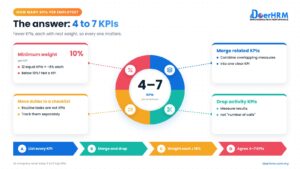
- A total of 4 to 7 KPIs per person; see how many KPIs per employee.
Frequently asked questions
What is a lagging KPI? A lagging KPI measures a result after it has happened, such as monthly revenue, debtor days or staff turnover. It comes too late to change that period’s result.
What is a leading KPI? A leading KPI measures an activity or early condition that predicts a future result, such as quotation value sent or maintenance completed on schedule. It gives managers time to act before the result is fixed.
Is revenue a leading or lagging KPI? Revenue is a lagging KPI. It is the end result of earlier activities such as leads, quotations and follow-ups, which are the leading KPIs.
Can a KPI be both leading and lagging? Yes, depending on the level. Qualified leads are a lagging result for the marketing team but a leading KPI for the sales team.
How many leading KPIs should an employee have? Usually one or two, alongside the main result KPIs. Too many leading KPIs turn the scorecard into an activity checklist.
How often should leading KPIs be reviewed? Weekly or fortnightly is common, because their value is early warning. Lagging KPIs are usually reviewed monthly or quarterly.
Conclusion
Lagging KPIs tell you whether you won. Leading KPIs tell you whether you are about to win, while there is still time to act. Keep your result KPIs, pair each important one with a driver your team controls, and review that driver more often.
Want your heads of department to build paired leading and lagging KPIs for every role? Request a customised KPI workshop proposal for your management team.
Ng Shone Fone is the Founder and CEO of DoerHRM and Group CEO of Obsnap. With 30 years in business, he is a Certified HRD Corp Trainer who helps Malaysian companies set clear, fair KPIs.