Executive coaching is a structured, one-to-one or small-group process where a trained coach helps a manager improve specific leadership behaviours, such as delegation or holding staff accountable, and link them to business results. A company needs it when capable managers are stuck on behaviour, not knowledge, and the cost of that gap is visible in their KPIs.
Key takeaways
- Coaching changes behaviour. Training builds knowledge. Mentoring passes on experience.
- Use executive coaching for managers who already know what to do but are not doing it consistently.
- Every coaching programme should start with 1 to 3 goals tied to the manager’s KPIs.
- Coaching does not fix unclear roles, missing KPIs or a manager who does not want to change.
- Measure results with KPI movement and behaviour feedback, not with how much the manager enjoyed the sessions.
By Ng Shone Fone, Founder and CEO of DoerHRM, with 30 years in business.
What is executive coaching?
Executive coaching is a series of focused conversations between a coach and a manager, aimed at changing how that manager leads. The coach asks questions, gives feedback and holds the manager to agreed actions between sessions.
Business coaching in Malaysia often covers the business itself, such as sales or strategy. Executive coaching focuses on the leader: how they plan, delegate, give feedback and follow up.
A good programme has three parties: the manager, the coach and a sponsor (usually the CEO or HR director) who agrees the goals and reviews progress. Coaching often sits inside a wider leader development programme, alongside training and on-the-job assignments.
How is coaching different from training and mentoring?
Training teaches skills to a group. Mentoring shares a senior person’s experience. Coaching helps one manager, or a small group, apply what they already know and change specific behaviours.
| Executive coaching | Training | Mentoring | |
|---|---|---|---|
| Main purpose | Change behaviour and results | Build knowledge and skills | Pass on experience and advice |
| Who leads | Trained coach (internal or external) | Trainer | Senior colleague |
| Format | One-to-one or small group, regular sessions | Classroom or online, group | Informal, as needed |
| Typical length | Several months | 1 to 3 days | Open-ended |
| Best for | “Knows what to do, but does not do it” | “Does not know how yet” | “Needs guidance and a network” |
| How success is judged | KPI and behaviour change | Test, skill check or application | Mentee’s own growth |
The three work well together: train first, then coach to apply it. If you are comparing training providers, see our guide on how to choose KPI training in Malaysia.
When does a company need executive coaching?
A company needs executive coaching when a manager’s behaviour, not their knowledge, is holding back team results, and the gap is costly enough to justify several months of focused support.
Common signs:
- A strong performer was promoted and is struggling. The best sales executive becomes sales manager and keeps selling instead of leading.
- The manager does everything personally. The team waits for their decisions.
- KPIs are set but not followed up. Monthly reviews are skipped or end without actions.
- Difficult conversations are avoided. Poor performance is tolerated until it becomes a disciplinary issue.
- A successor is being prepared. A future head of department needs to think beyond their current role.
In our coaching work with Malaysian managers, the most common goal is delegation . Coaching helps them decide what to hand over, to whom, and how to follow up without taking it back.
If the issue is that your managers do not yet coach their own staff, read our article on managers as coaches.
How does an executive coaching programme work?
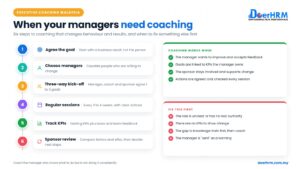
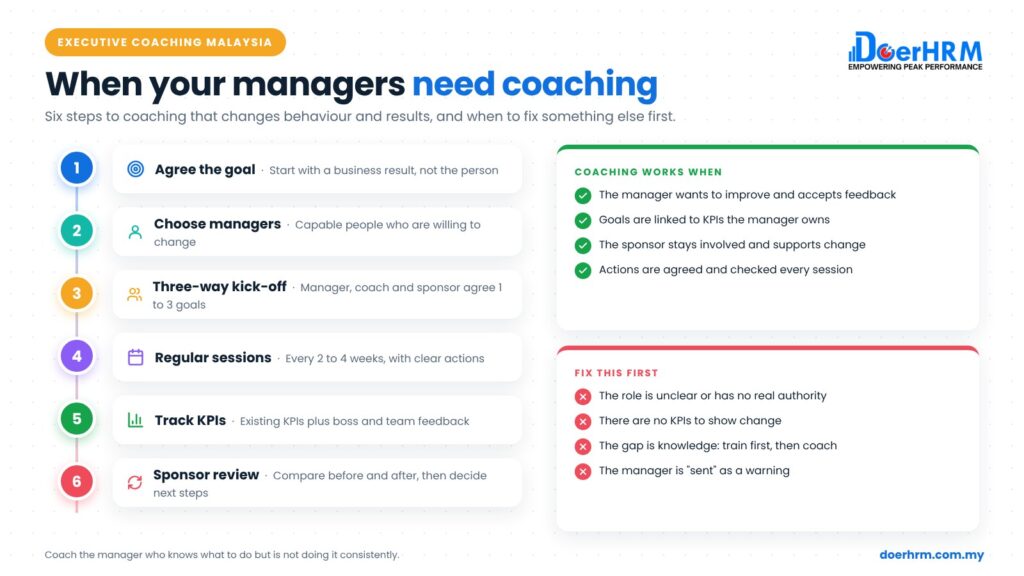
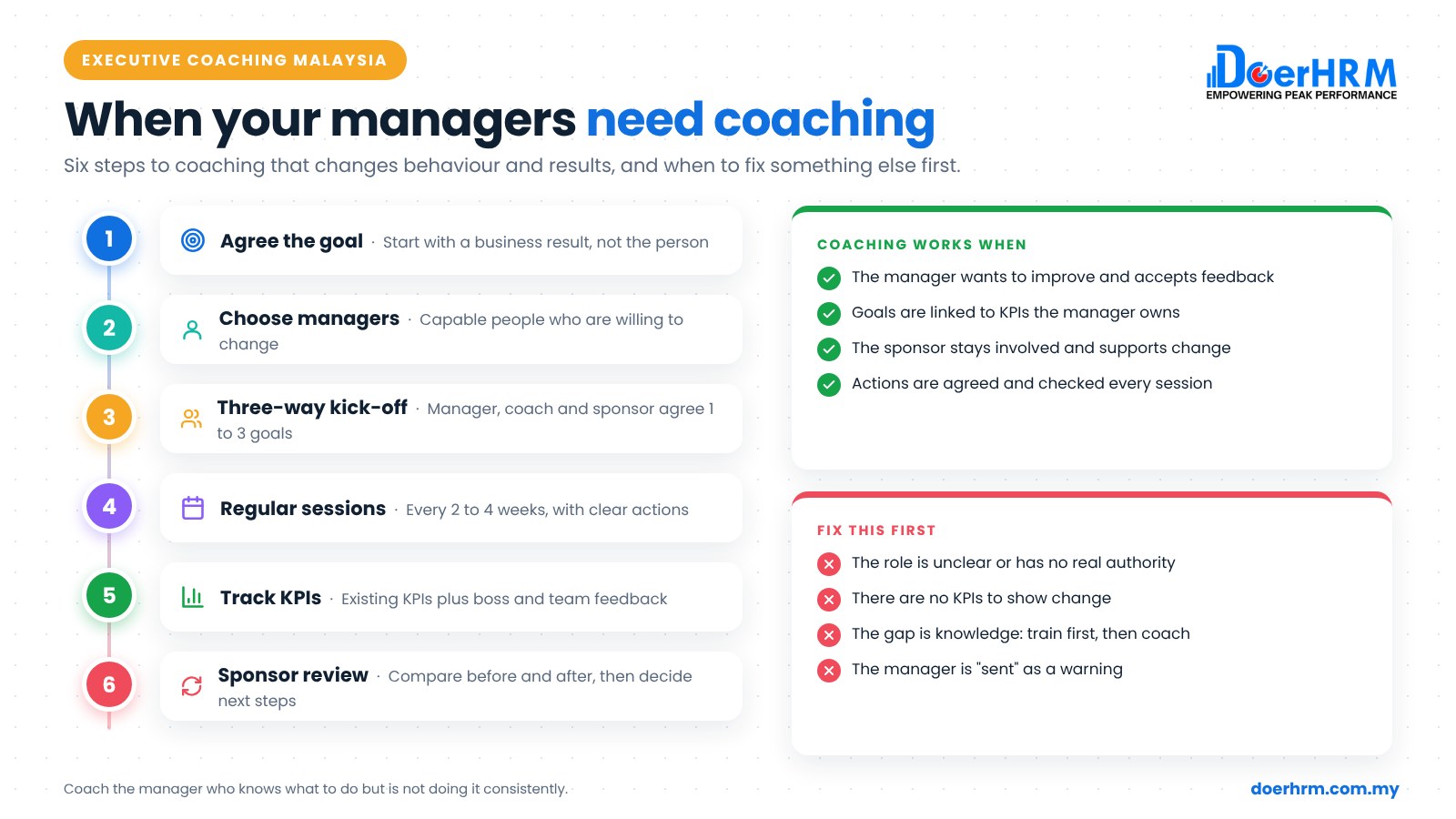
A practical programme runs in six steps: agree the business goal, choose the right managers, hold a three-way kick-off, run regular sessions, track KPIs and behaviour, then review with the sponsor.
- Agree the business goal. Start with the result, not the person, for example “95% on-time delivery”.
- Choose the managers. Pick people who are capable and willing. Coaching is not a last step before dismissal.
- Hold a three-way kick-off. The manager, coach and sponsor agree 1 to 3 coaching goals, how progress will be measured and what stays confidential.
- Run regular sessions. Most programmes meet every two to four weeks for several months. Each session ends with 1 to 3 agreed actions.
- Track KPIs and behaviour. Use the manager’s existing KPIs plus short feedback from their boss and team at the start and end.
- Review with the sponsor. Compare before and after, and decide whether to continue.
The tracking step is easier when KPIs already exist. If they do not, set them first using a clear KPI performance management process, or coaching goals will stay vague.
Is executive coaching just expensive advice?
No, when it is aimed at a clear goal, with a willing manager and measurable results. Yes, it can be, when it replaces fixing the role, the KPIs or a hiring mistake.
When coaching works
- The manager wants to improve and accepts feedback.
- Goals are specific and linked to KPIs the manager owns.
- The sponsor stays involved and supports change (for example, gives the manager authority to delegate).
- Actions are agreed and checked every session.
When coaching does not work
- The role is unclear or the manager has no real authority. Fix the structure first.
- There are no KPIs, so nobody can tell whether anything changed.
- The problem is missing knowledge. Train first, then coach.
- The manager is being “sent” to coaching as a warning and does not want to change.
- The real issue is a values or integrity problem. That needs a management decision, not a coach.
Worked example: coaching a production manager (hypothetical)
Hypothetical example: Hafiz is a production manager at a Malaysian manufacturer. His team misses delivery dates, and he works late fixing problems himself. The CEO sponsors six months of coaching with two goals: delegate daily problem-solving to supervisors, and run a weekly KPI review.
| Measure | Before coaching | Target after 6 months | Actual after 6 months |
|---|---|---|---|
| On-time delivery | 82% | 90% | 88% |
| Weekly KPI review held | 4 of 12 weeks | 12 of 12 weeks | 11 of 12 weeks |
| Problems escalated to Hafiz per week | 15 | 6 | 7 |
| Team feedback: “My manager gives me clear priorities” (1 to 5) | 2.8 | 3.8 | 3.9 |
On-time delivery rose 6 percentage points (82% to 88%), close to target. Escalations fell from 15 to 7 a week, so supervisors were solving more problems themselves. The sponsor agreed three more months on the remaining gap.
One-to-one or group coaching?
One-to-one coaching suits senior leaders with personal goals. Group coaching suits a layer of managers working on the same skills, and costs less per person.
For example, DoerHRM’s Live Mastery Coaching is monthly group coaching for groups of 12 managers, at RM299 per manager per month, billed annually . For a group of 12 managers, that is 12 × RM299 × 12 months = RM43,056 a year. DoerHRM’s High Performance Training (2-day face-to-face training plus 3 months of online coaching) is 100% HRD Corp claimable under programme no. 10001154578.
If your goal is aligning managers on company OKRs rather than individual behaviour, consider OKR coaching and planning sessions instead.
Frequently asked questions
What is executive coaching? Executive coaching is a structured process where a coach helps a manager change specific leadership behaviours, such as delegation or feedback, and link them to business results over several months.
When does a company need executive coaching? When a capable manager knows what to do but is not doing it consistently, and the gap shows in their team’s KPIs. Common cases are newly promoted managers, managers who do everything themselves, and successors being prepared.
What is the difference between executive coaching and business coaching in Malaysia? Business coaching often covers the business itself, such as sales, strategy or growth. Executive coaching focuses on the leader’s own behaviour and how they manage people.
How do you measure the results of executive coaching? Compare the manager’s KPIs and short feedback from their boss and team before and after coaching. Agree these measures at the kick-off, not at the end.
Is executive coaching HRD Corp claimable? It depends on the programme. DoerHRM’s High Performance Training, which includes 3 months of online coaching, is 100% HRD Corp claimable (programme no. 10001154578). Check each provider’s programme number.
Conclusion
Executive coaching pays off when a capable, willing manager needs to change how they lead, with goals tied to KPIs you can track. It does not fix unclear roles, missing KPIs or a knowledge gap.
Thinking about coaching for your managers? Discuss your manager-development needs with our team.
Ng Shone Fone is the Founder and CEO of DoerHRM and Group CEO of Obsnap. With 30 years in business, he is a Certified HRD Corp Trainer who coaches Malaysian managers to turn strategy into clear KPIs and results.