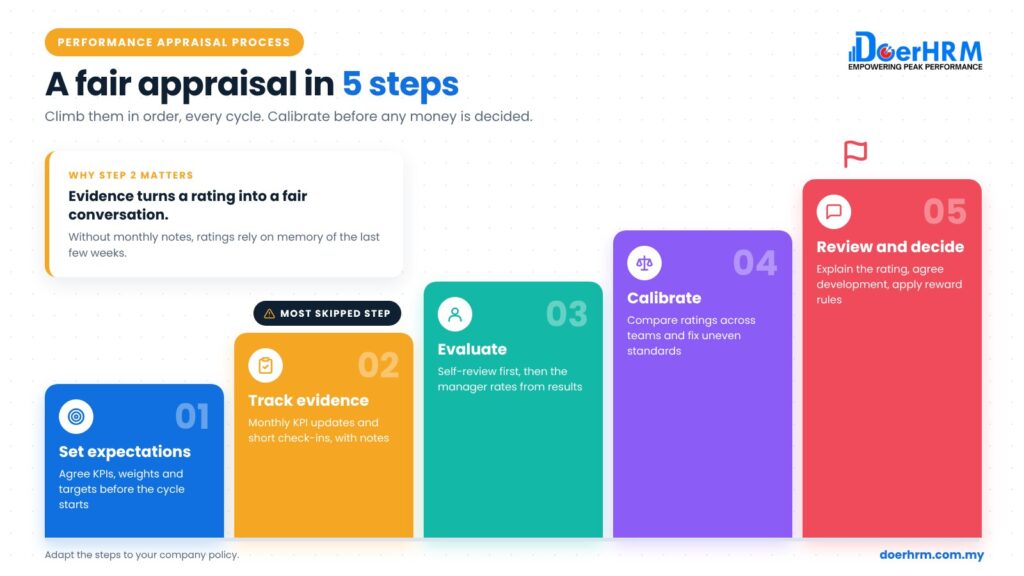
The performance appraisal process has 5 steps: set clear KPIs and expectations, track progress and collect evidence through the year, evaluate with a self-review and manager rating, calibrate ratings across departments, then hold the review meeting and link the result to rewards and development. Step 2 is the step most companies skip.
Key takeaways
- A fair performance appraisal process is a cycle of 5 steps, not one form at year end.
- Step 2, tracking progress and collecting evidence during the year, is the step most often skipped.
- Without step 2, ratings depend on memory, and the last two or three months count the most.
- Calibrate ratings across managers before deciding bonuses and increments.
By Ng Shone Fone, Founder and CEO of DoerHRM, with 30 years in business.
Employees rarely complain about getting a 3 instead of a 4. They complain when they cannot see why. The 5 steps below make every rating traceable to evidence. They sit inside your wider KPI performance management system.
What are the 5 steps in the performance appraisal process?
The 5 steps are: set expectations, track and collect evidence, evaluate, calibrate, and review and decide. Each step has a clear owner and output, so the final rating is based on facts rather than impressions.
- Set expectations. Agree KPIs, weights, targets and competencies at the start of the cycle.
- Track and collect evidence. Update KPI results monthly and hold short check-ins, with notes.
- Evaluate. The employee completes a self-review; the manager rates using the evidence.
- Calibrate. HR and managers compare ratings across teams and correct uneven standards.
- Review and decide. Hold the appraisal meeting, confirm the rating, then link it to rewards and a development plan.
| Step | When | Who | Output |
|---|---|---|---|
| 1. Set expectations | Start of the year (or probation) | Manager and employee | Agreed KPIs and targets |
| 2. Track and collect evidence | Monthly and quarterly, all year | Employee updates, manager verifies | KPI results, check-in notes |
| 3. Evaluate | End of cycle | Employee, primary and secondary evaluator | Self and manager ratings |
| 4. Calibrate | After ratings, before rewards | HR and department heads | Final ratings |
| 5. Review and decide | After calibration | Manager, HR, management | Rewards, development plan |
Step 1: How do you set clear expectations?
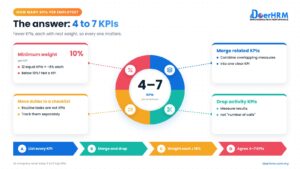
Agree 4 to 7 KPIs per employee, each with a weight, target and data source, plus a short list of competencies. Confirm them in writing before the cycle starts.
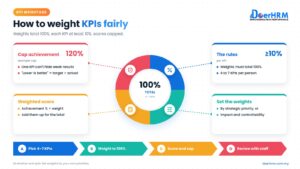
“Improve customer service” cannot be rated objectively. “Resolve 90% of complaints within 48 hours” can. Use role-based employee KPI examples as a starting point, and set the weights so the most important result counts the most. Our guide to KPI weightage explains how.
Add 4 to 6 competencies (for example, teamwork or problem solving), each with a description for every rating level. That way a “3” means the same thing to every manager.
Step 2: Why is tracking and evidence collection the step most companies skip?
Because it has no deadline. Year-end appraisals have a due date; monthly updates and check-ins do not, so they are the first thing dropped when managers get busy.
When step 2 is skipped, three problems follow:
- Recency bias. The manager remembers October to December, not the whole year.
- Surprises. The employee hears about a problem for the first time at year end, when it is too late to fix.
- No evidence. The manager cannot explain the rating, so it feels personal.
What step 2 looks like in practice:
- Monthly: the employee updates KPI actuals; the manager verifies them.
- Quarterly: a 20 to 30 minute check-in on what is on track, what is behind and what help is needed. Note two or three lines.
- Mid-year: a formal progress review. Change targets only if business conditions have changed, and record why.
A problem spotted in March can be fixed by June. A problem first raised in December only becomes a lower bonus.
Step 3: How should managers evaluate performance fairly?
Start with the employee’s self-review, then rate each KPI from the actual results and each competency against its written description. Every rating below or above “meets expectations” should have a comment that points to evidence.
Good practice for this step:
- Score KPIs from data. Achievement = actual ÷ target (or target ÷ actual when lower is better).
- Add a second evaluator for key roles, such as the head of department.
- Write specific comments. “Resolved 104% of target in Q1 to Q3; Q4 dropped after the system change” is useful. “Good attitude” is not.
Step 4: What happens in calibration?
In calibration, HR and department heads compare ratings across teams, question ratings that look out of line, and agree final ratings before any money is decided. It stops one generous or strict manager from changing what their team is paid.
If one team has nearly everyone rated “outstanding” and another has almost none, the managers explain their evidence. A bell curve (forced distribution) can be used as a guide here, not a strict quota, especially for small teams. Many companies also plot people on a 9-box grid to separate current performance from future potential.
In DoerHRM, HR runs the bell curve and 9-box matrix on the ratings managers submit, with no copying between spreadsheets.
Step 5: How do you close the review and link it to rewards?
Hold a one-to-one appraisal meeting to explain the final rating and the evidence behind it, agree a development plan, then apply the calibrated rating to bonuses and increments using a written formula.
In the meeting, cover the rating and why, what went well, and what to focus on next year. Then apply the same rating-to-reward rules to everyone, within budget. See how to calculate a performance bonus and how to decide salary increments using KPI scores.
If an appraisal may lead to a performance improvement plan or disciplinary action, follow your written company policy and check with an employment law adviser before acting.
Worked example: how step 2 changes a rating (hypothetical)
Hypothetical example: Mei Ling, a Customer Service Executive at a Malaysian online retailer, had a strong first nine months and a weak fourth quarter. Rated from memory, she gets a 3. Rated from the full year’s evidence, she gets a 4.
Her monthly records show achievement on the complaints KPI of 104% in Q1, 105% in Q2, 106% in Q3 and 89% in Q4, an average of 101%. The Q4 check-in notes explain the dip: a new order system went live in October.
| KPI | Weight | Full-year achievement | Weighted score | Q4 only (“from memory”) | Weighted score |
|---|---|---|---|---|---|
| Complaints resolved within 48 hours | 40% | 101% | 40.40% | 89% | 35.60% |
| Customer satisfaction score | 35% | 104% | 36.40% | 92% | 32.20% |
| Quality audit score | 25% | 98% | 24.50% | 95% | 23.75% |
| Total | 100% | 101.30% | 91.55% |
Using the bands 100% to below 110% = 4 (exceeds expectations) and 80% to below 100% = 3 (meets expectations):
- With step 2 evidence: 101.30% gives a rating of 4.
- Without it: 91.55% gives a rating of 3.
That one-band difference changes her bonus and increment, and the check-in notes show the Q4 dip came from a system change, not her effort.
Frequently asked questions
What are the 5 steps in the performance appraisal process? Set expectations, track progress and collect evidence, evaluate, calibrate, and review and decide. Together they make sure the final rating is based on evidence collected throughout the year.
Which step of the appraisal process is most often skipped? Step 2, tracking progress during the year. Monthly KPI updates and quarterly check-ins have no fixed deadline, so they are dropped first, which leads to recency bias and year-end surprises.
How often should performance appraisals be done? Most companies hold a formal appraisal once or twice a year, with monthly KPI updates and quarterly check-ins in between. New staff are often also reviewed at the end of probation.
What is calibration in performance appraisal? Calibration is a meeting where HR and department heads compare ratings across teams and agree final ratings. It makes sure every manager applies the same standard before bonuses and increments are decided.
Should employees rate themselves? Yes. A self-review helps the employee reflect and often brings up achievements the manager missed. The manager’s rating, based on evidence, still decides the final score before calibration.
Conclusion
A fair performance appraisal process depends less on the form than on the 5 steps around it, especially step 2. Agree clear KPIs, keep monthly results and check-in notes, calibrate before money is discussed, and explain every rating with evidence.
Want to see how monthly KPI updates, appraisal ratings and calibration fit together in one place? Book a free session with a DoerHRM expert. Our Performance Appraisal & Analytics module links evaluator ratings, HR calibration, bonus and increment.
Ng Shone Fone is the Founder and CEO of DoerHRM and Group CEO of Obsnap. With 30 years in business, he is a Certified HRD Corp Trainer who helps Malaysian companies set clear, fair KPIs.