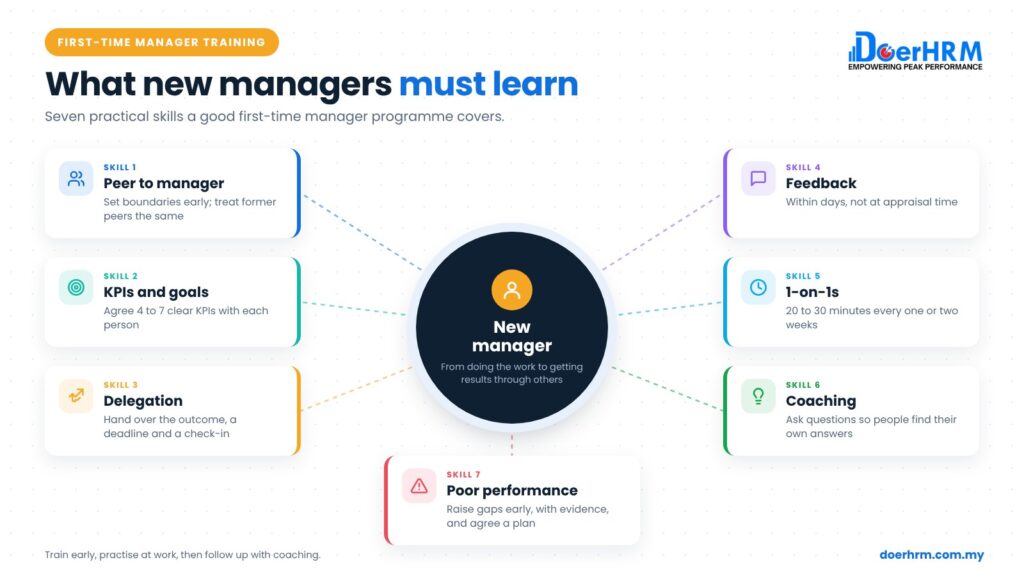
Good leadership training for first-time managers in Malaysia covers seven practical skills: moving from peer to manager, setting KPIs and goals, delegating, giving feedback, running 1-on-1s, coaching conversations and handling poor performance. Strong programmes mix short workshops with real practice at work and follow-up coaching over several months.
Key takeaways
- A good first-time manager training programme covers 7 core skills, with KPIs and feedback at the centre.
- Practice and follow-up matter more than the length of the classroom session.
- The 3 most common early mistakes: setting KPIs alone, saving feedback for year end, and giving feedback without evidence.
- When choosing leadership training in Malaysia, check content, format, trainer experience, follow-up and HRD Corp status.
By Ng Shone Fone, Founder and CEO of DoerHRM, with 30 years in business.
In many Malaysian companies, the best sales executive becomes the sales supervisor, and the most reliable technician becomes the workshop lead. But the skills that made them good at their old job are not the skills they need now.
Without support, some new managers keep doing the work themselves and become a bottleneck. Others avoid hard conversations with people who were their friends last month. This guide explains what leadership training for new managers should cover, what format works and how to choose a programme. It builds on our article on managers as coaches.
Why do first-time managers need leadership training?
Because managing people is a different job, not a bigger version of the old one. New managers need to learn how to get results through others: set clear goals, delegate, give feedback and deal with problems early.
In our KPI workshops, newly promoted supervisors often tell us they were given the title and a team on the same day, with no guidance on what “managing” means. They learn by trial and error.
The shift is from being measured on your own output to being measured on your team’s results. Training makes that shift faster and less painful, for the manager and the team.
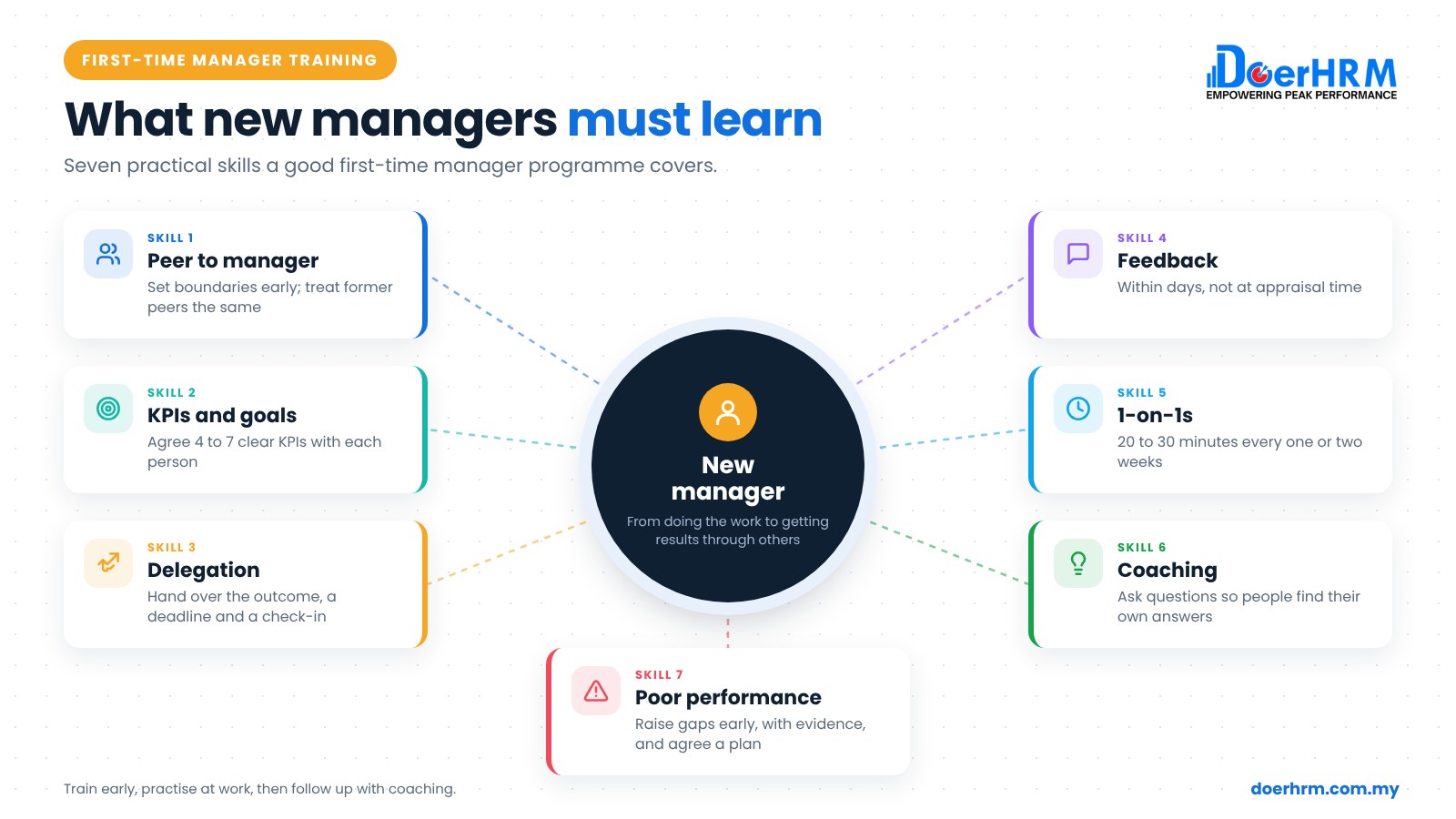
What should a first-time manager training programme cover?
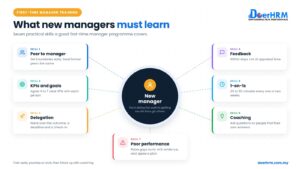
A first-time manager programme should cover seven skills: moving from peer to manager, KPIs and goal setting, delegation, feedback, 1-on-1 meetings, coaching conversations and handling poor performance. Each should be practised, not just explained.
| Topic | What it covers | Sign it is working |
|---|---|---|
| 1. Peer to manager | Changing role, setting boundaries, being fair to former friends | The manager makes decisions without avoiding or favouring old peers |
| 2. KPIs and goal setting | Turning department goals into 4 to 7 clear KPIs per person, with targets and weights | Every team member can name their KPIs and targets |
| 3. Delegation | What to delegate, to whom, and how to follow up | The manager spends less time on tasks the team can do |
| 4. Feedback | Specific, timely feedback on results and behaviour | Feedback is given weekly, not saved for the appraisal |
| 5. 1-on-1 meetings | A regular, short meeting with each team member | 1-on-1s happen on schedule with brief notes |
| 6. Coaching conversations | Asking questions so the employee finds the answer | Team members bring solutions, not only problems |
| 7. Handling poor performance | Spotting gaps early, agreeing an improvement plan, documenting | Problems are raised in month 1, not month 11 |
How do new managers move from peer to manager?
By being clear about the new role from day one: meet the team, explain how you will work together, and apply the same standards to everyone. A good programme gives new managers a script and a plan for their first 30 days.
Practical points a programme should teach:
- Talk early. Meet each former peer one-to-one in the first week and acknowledge the change.
- Be consistent. Same rules on attendance, KPIs and recognition for everyone, including friends.
- Learn before changing. Quick changes can look like a show of power.
- Find a sounding board. A mentor or coach for decisions the manager cannot discuss with the team.
How should a programme teach KPIs and goal setting?
It should teach new managers to translate department goals into a small number of clear, measurable KPIs for each person, agree them with the employee, and review them every month. This is the base for every later conversation about performance.
Without clear KPIs, feedback and appraisal have nothing objective to refer to. A good module covers:
- What makes a KPI measurable (formula, target, data source, frequency). Our guide to SMART KPIs is a useful reference.
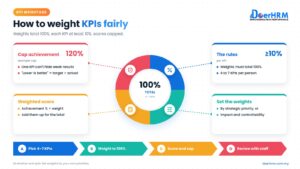
- How many KPIs each person should have (usually 4 to 7) and how to set weights.
- How to cascade department KPIs to each person and review them monthly.
If KPI setting is a big gap across your managers, a dedicated KPI training programme can be run alongside the leadership programme.
What delegation, feedback and 1-on-1 skills should be covered?
New managers need a simple method for each: delegate outcomes with a clear deadline and check-in point, give feedback that describes the behaviour and its impact, and hold a short 1-on-1 with each team member every one or two weeks.
Delegation. Many new managers hold on to work because “it is faster if I do it”. A programme should teach them to delegate the outcome, not just the task: what good looks like, by when, and when they will check in.
Feedback. A simple structure works well: describe what happened, explain the impact, and agree the next step. For example: “The report was two days late. Finance could not close the month on time. What do you need to get it in by the 3rd next month?” Give it within days, for good work as well as problems.
1-on-1 meetings. A 20 to 30 minute meeting every one or two weeks. A useful agenda: KPI progress, what is getting in the way, support needed and one development topic. Brief notes become evidence for the year-end appraisal.
What makes a coaching conversation different?
In a coaching conversation, the manager asks questions instead of giving the answer, so the employee builds their own problem-solving skill. It takes practice, because telling feels quicker.
A simple coaching structure many programmes use is GROW: Goal (what do you want to achieve?), Reality (what is happening now?), Options (what could you do?) and Will (what will you do, and by when?). The hard part is not the model but resisting the urge to give the answer. Role-play in class, then real conversations at work with feedback from a coach, builds the habit.
How should new managers handle poor performance?
Raise the gap early, privately and with evidence. Agree what good looks like, the support given and a review date. Document each step and involve HR before any formal action.
A good programme teaches new managers to:
- Check the basics. Were expectations clear? Did the employee have the tools and training?
- Use facts. Refer to KPI results and specific examples, not personality.
- Agree a plan. Clear targets, support and a review date.
- Follow up as promised. Review on the agreed date and record the outcome.
- Bring in HR early. Especially if formal action may follow.
This is general guidance only. Before any formal performance or disciplinary process, follow your company policy and check with an employment law adviser.
What are the 3 mistakes new managers make with KPIs and feedback?
The three most common mistakes are setting KPIs for the team without agreeing them, saving feedback for the year-end appraisal, and giving feedback about attitude instead of KPI evidence. All three are easy to fix with training and a simple routine.
Mistake 1: Setting KPIs alone. New managers often copy last year’s KPIs or write new ones at their desk and send them out. The team does not own them. The fix: draft the KPIs, then agree targets with each person and confirm in writing.
Mistake 2: Saving feedback for the appraisal. New managers often avoid difficult conversations, especially with former peers. The employee then hears about the problem for the first time at year end, and the rating feels unfair. The fix: give feedback within the week, using monthly KPI reviews and 1-on-1s.
Mistake 3: Feedback without evidence. “You need to be more proactive” is hard to act on and easy to dispute. The fix: link feedback to a KPI result or a specific example. “Your quotation conversion rate was 18% against a 25% target this quarter. Let’s look at the last five quotations together.”
What format works best for first-time manager training?
The most effective format combines short, practical workshops with practice at work and follow-up coaching over two to six months. A single one-day course rarely changes habits on its own.
| Format | Good for | Limitation |
|---|---|---|
| One-off workshop (1 to 2 days) | Introducing concepts and tools quickly | Habits fade without follow-up |
| Series of shorter sessions over months | Practising one skill at a time between sessions | Needs commitment and scheduling |
| Workshop plus group coaching | Applying skills to real team issues, with peer learning | Requires an experienced coach |
| Online course | Flexible, self-paced learning of concepts | Little practice or feedback on real conversations |
For most Malaysian SMEs, a short face-to-face workshop followed by monthly group coaching is a practical balance.
At DoerHRM, our Leader Development Programme is designed for managers and team leaders.
How do you choose leadership training in Malaysia?
Choose a programme by checking five things: whether the content matches your new managers’ real gaps, whether it includes practice and follow-up, the trainer’s management experience, how results will be measured, and the HRD Corp status of the specific programme.
Use this checklist when comparing providers:
- Define the gaps first. Ask new managers and their bosses which of the 7 skills are weakest.
- Check the content. KPIs, feedback, 1-on-1s, coaching and poor performance, not only leadership theory.
- Check for practice. Role-plays, real cases and assignments at work between sessions.
- Check the follow-up. Coaching or a review session after the workshop.
- Check the trainer. Have they managed people and teams in a business setting?
- Agree how you will measure it. For example, 1-on-1s held and KPIs agreed for every team member.
- Check HRD Corp status. Ask for the programme number and confirm it is registered as claimable.
Many of the same questions apply to KPI training. See how to choose KPI training in Malaysia for a fuller checklist.
Worked example: a 90-day plan for a new supervisor (hypothetical)
Hypothetical example: Hafiz has just been promoted from senior technician to Service Supervisor at a Malaysian air-conditioning service company. He leads 6 technicians, two of whom were his peers. His 90-day plan links training to practice at work.
| Weeks | Focus | Actions at work |
|---|---|---|
| 1 to 2 | Peer to manager | 1-to-1 meeting with each of the 6 technicians; agree how the team will work |
| 3 to 4 | KPIs and goal setting | Agree 4 to 5 KPIs per technician (for example, jobs completed, first-time fix rate, customer rating) |
| 5 to 8 | Feedback and delegation | Delegate the weekly job schedule to one senior technician; give feedback within the week |
| 9 to 12 | Coaching and poor performance | Use GROW in 1-on-1s; agree an improvement plan with one technician whose fix rate is below target |
The time Hafiz needs for 1-on-1s: 6 technicians × 30 minutes every 2 weeks = 180 minutes, or 3 hours per fortnight. Over 12 weeks (6 fortnights), that is 18 hours in total. It replaces many unplanned interruptions and gives him dated notes for the appraisal.
At day 90, his manager checks: KPIs agreed for all 6 technicians, 1-on-1s held on schedule, improvement plan on track.
Is leadership training HRD Corp claimable?
It depends on the specific programme. Only programmes registered with HRD Corp can be claimed, so ask the provider for the programme number and confirm it before you book.
At DoerHRM, High Performance Training (2-day face-to-face training plus 3 months of online coaching) is 100% HRD Corp claimable under programme no. 10001154578. For any other programme, check its status with the provider and HRD Corp before budgeting.
Frequently asked questions
What should a first-time manager training programme cover? It should cover moving from peer to manager, setting KPIs and goals, delegation, feedback, 1-on-1 meetings, coaching conversations and handling poor performance. Each skill should be practised at work, not just explained in class.
When should a new manager be trained? Ideally in the first one to three months after promotion, before habits form. Some companies start training high-potential staff before they are promoted.
What is the most important skill for a first-time manager? Setting clear KPIs and giving regular feedback against them. Without clear goals, delegation, coaching and appraisal all become harder and more subjective.
Is leadership training in Malaysia HRD Corp claimable? Only if the specific programme is registered with HRD Corp. Ask the provider for the programme number. DoerHRM’s High Performance Training is 100% claimable under programme no. 10001154578.
How do you measure whether manager training worked? Agree measures before training starts, such as KPIs agreed for every team member, 1-on-1s held on schedule and team feedback after 3 to 6 months. Then review them with the manager’s own boss.
What is the difference between leadership training and KPI training? Leadership training covers the whole job of managing people, including feedback, coaching and difficult conversations. KPI training focuses on setting, weighting and reviewing KPIs. New managers usually need both.
Conclusion
First-time managers are usually promoted for being good at their job, then left to work out the rest. A good leadership programme gives them seven practical skills, with KPIs and feedback at the centre, and time to practise at work. When choosing leadership training in Malaysia, check for practice, follow-up, trainer experience and HRD Corp status.
Promoting new managers in the coming year? Discuss your manager-development needs with our team, and we will suggest a programme that fits their gaps.
Ng Shone Fone is the Founder and CEO of DoerHRM and Group CEO of Obsnap. With 30 years in business, he is a Certified HRD Corp Trainer who coaches Malaysian managers on KPIs, feedback and leading teams.