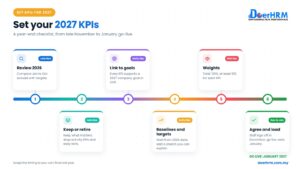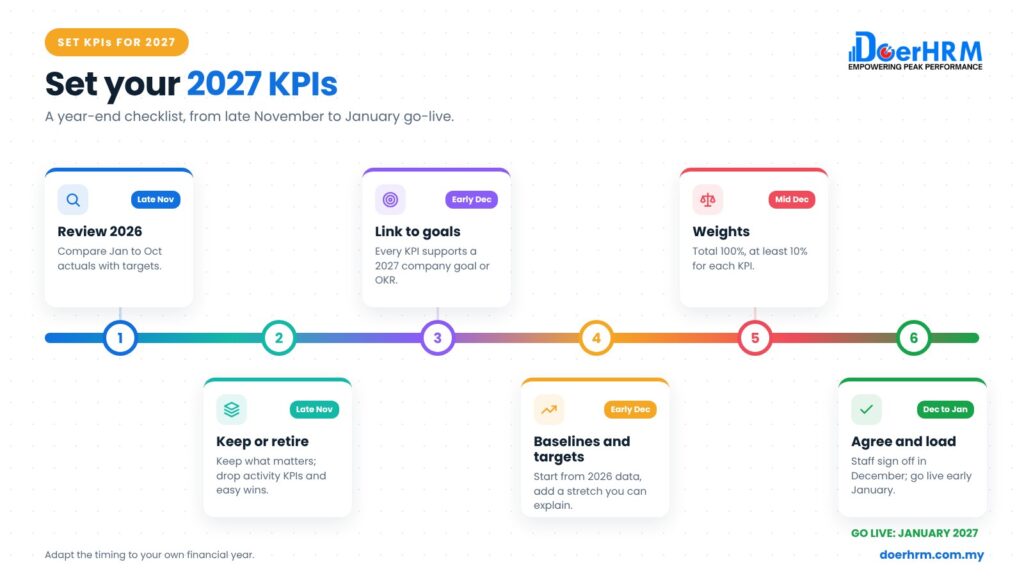
To set KPIs for 2027, start now: review 2026 results in late November, keep, change or retire each KPI, link the list to your 2027 company goals and OKRs, then set baselines, weights and targets in December. Agree them with each employee and load them into your system before the first week of January.
Key takeaways
- KPI setting for 2027 is an 8-step job that takes about six weeks. Start in late November, not in January.
- Review every 2026 KPI first and decide: keep, change or retire.
- Set 2027 targets from 2026 baseline data, not from last year’s targets.
- Weights must total 100%, with at least 10% for each KPI.
- Staff should see and agree their KPIs before 1 January, so the first month counts.
By Ng Shone Fone, Founder and CEO of DoerHRM, with 30 years in business.
In our KPI workshops, the most common year-end problem we see is KPIs that arrive in March. By then, a quarter of the year has gone without clear targets. This checklist gets your 2027 KPIs ready before January. For the basics of writing a single KPI, see our guide on how to set key performance indicators for employees.
When should you start setting KPIs for 2027?
Start in the last week of November. You need about two weeks to review 2026, three weeks in December to set and agree the new KPIs, and the first week of January to load and confirm them.
December is short: staff take year-end leave and managers are busy with appraisals. This timeline assumes a January to December financial year. If yours differs, shift the dates.
| When | What to do | Who | Output |
|---|---|---|---|
| Late Nov (25 Nov to 4 Dec) | Review 2026 results; decide keep, change or retire for each KPI | HR and heads of department | 2026 KPI review sheet |
| Early Dec (7 to 11 Dec) | Confirm 2027 company goals and OKRs; cascade to departments | Management team | 3 to 5 company KPIs, department KPI lists |
| Mid Dec (14 to 18 Dec) | Set baselines, weights and targets | Heads of department, with HR | Draft scorecards |
| Late Dec (21 to 24 Dec) | Agree KPIs with each employee | Managers and staff | Signed-off scorecards |
| Early Jan (4 to 8 Jan 2027) | Load into the system, approve, go live | HR and system admin | Live 2027 scorecards |
| End Jan 2027 | First monthly update | Staff, verified by managers | January actuals |
What is the year-end KPI checklist?
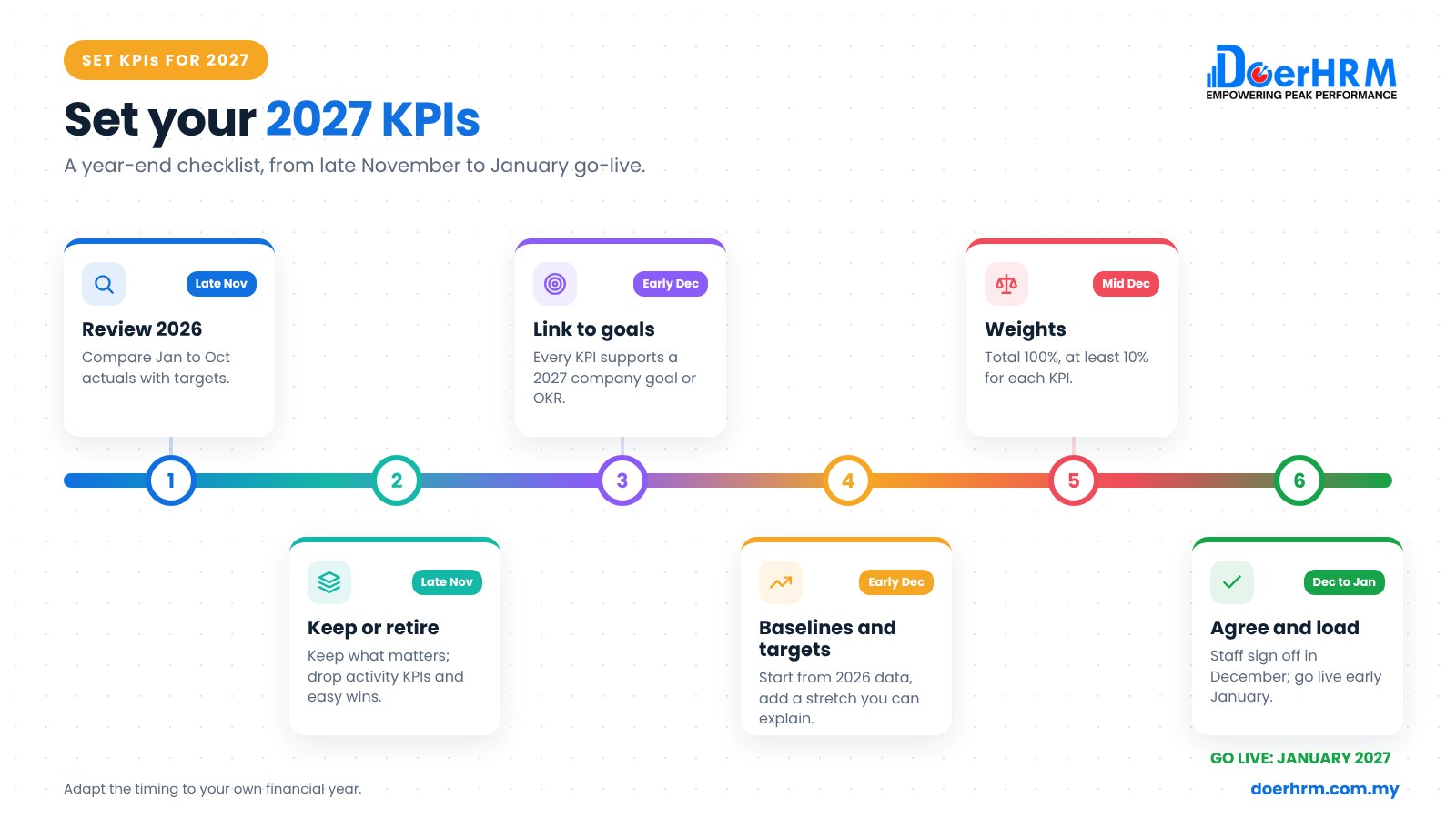
The checklist has 8 steps: review 2026, decide keep or retire, link to 2027 goals, set baselines, set weights, set targets, agree with staff, and load into the system.
- Review 2026 results. Use January to October actuals. Do not wait for December.
- Keep, change or retire each KPI. Retire activity KPIs and anything met every month with no effort.
- Link to 2027 company goals and OKRs. Each department KPI should support a company KPI or OKR.
- Set baselines from 2026 data. Usually the 2026 average. For a new KPI, use the last two or three months.
- Set weights. Total 100%, at least 10% each. That usually means 4 to 7 KPIs per person.
- Set targets. Baseline plus a realistic stretch. A target never reached in 2026 needs a reason to stay.
- Agree with each employee. Explain the link to company goals and record the agreement in writing.
- Load into the system before January. Enter formulas, data sources, baselines, targets and owners.
How do you review 2026 KPIs?
For each 2026 KPI, compare the actual with the target, check whether the data was reliable, and ask one question: did this KPI help us make better decisions this year?
Achievement is actual ÷ target (or target ÷ actual when lower is better). Then sort each KPI:
- Keep: still linked to a 2027 goal, with reliable data.
- Change: right idea, but the formula, data source or target needs fixing.
- Retire: an activity count, a KPI nobody updated, or a duty always met. Move it to a supervisor checklist.
The review also feeds the appraisal. See our performance appraisal process for how results become ratings.
How do you link 2027 KPIs to company goals and OKRs?
Agree 3 to 5 company KPIs and one or two company OKRs for 2027 first, then cascade them. Each department picks the KPIs it directly drives.
KPIs track ongoing results; OKRs drive a specific improvement. Most SMEs need both. Our guide to OKR vs KPI explains the difference.
Test every department KPI: which company goal does it move? If nobody can answer, it is probably habit.
How do you set weights and targets for 2027?
Give the biggest weight to the KPI that most affects the company goal, keep every KPI at 10% or more, and set targets as baseline plus a stretch you can explain.
- Weights: total 100%, minimum 10%. Our KPI weightage guide shows how to decide the split, and our guide on how many KPIs per employee explains why 4 to 7 works.
- Targets: write the baseline next to the target. If the gap is large, say what will change in 2027 to close it. Our SMART KPI guide helps test each one.
Worked example: one department’s 2026 review and 2027 KPIs (hypothetical)
Hypothetical example: Hafiz is logistics manager at a Malaysian distribution company. His department had 6 KPIs in 2026. After the year-end review, he keeps 4, retires 2 and adds 1 new KPI linked to a company OKR.
Step 1 and 2: review of 2026 (January to October actuals)
| 2026 KPI | 2026 target | Actual (Jan to Oct) | Achievement | Decision |
|---|---|---|---|---|
| On-time delivery rate | 95% | 91.2% | 96.0% | Keep, reset target from baseline |
| Delivery cost per order (lower is better) | RM14.00 | RM15.20 | 92.1% | Keep |
| Picking accuracy | 99.0% | 99.6% | 100.6% | Keep, raise target, lower weight |
| Stock count accuracy | 98.0% | 98.9% | 100.9% | Keep, raise target |
| Trucks serviced on schedule | 100% | 100% | 100% | Retire: met every month, move to checklist |
| Safety briefing attendance | 100% | 98% | 98% | Retire: activity, move to checklist |
On-time delivery rose from 89.5% in January to 91.8% in October, averaging 91.2%. The highest month was 92.0%, so the 95% target was never reached in any month.
Steps 3 to 6: 2027 KPIs
The company’s 2027 goals are to keep key customers and protect margin. Its 2027 OKR is to grow online orders.
| 2027 KPI | Linked to | Baseline | 2027 target | Weight |
|---|---|---|---|---|
| On-time delivery rate | Keep key customers | 91.2% | 94% | 30% |
| Delivery cost per order (lower is better) | Protect margin | RM15.20 | RM14.50 | 25% |
| Online orders dispatched same day (new) | OKR: grow online orders | 82% (Sep to Oct) | 90% | 20% |
| Stock count accuracy | Protect margin | 98.9% | 99.5% | 15% |
| Picking accuracy | Keep key customers | 99.6% | 99.7% | 10% |
| Total | 100% |
What changed:
- On-time delivery: 94% is a stretch of 2.8 points on the baseline, backed by a new route plan. It replaces a 95% target nobody believed in.
- Delivery cost: RM14.50 is a cut of RM0.70 (4.6%) from baseline.
- New KPI: same-day dispatch has only two months of data, so the target is reviewed at the end of March.
Hafiz agrees the scorecard with his supervisors on 22 December. HR loads it in early January.
How do you load 2027 KPIs into your system before January?
Enter each KPI with its formula, data source, baseline, target, weight and owner, link it to its company goal, and get manager approval by the first working week of January.
In DoerHRM, effective periods let 2027 KPIs start on 1 January without overwriting 2026, and one KPI can have several owners, each with their own target. Supervisors then approve monthly actuals. For the wider picture, see our guide to KPI performance management.
Frequently asked questions
When should a company set KPIs for the next year? Start in late November and finish by the first week of January. That gives about six weeks to review the current year, agree new KPIs and load them before the year starts.
Should we keep the same KPIs as last year? Keep only those still linked to next year’s goals with reliable data. Change KPIs with unclear formulas, and retire activity counts and duties that are always met.
How do you set a KPI target for next year? Start from the baseline, usually this year’s average, then add a stretch you can explain. Write the baseline next to the target so everyone can see the gap.
What if a KPI is new and has no baseline? Use two or three months of recent data as a starting baseline, set a provisional target, and review it at the end of the first quarter.
How do OKRs fit into annual KPI setting? Set company OKRs for the one or two improvements that matter most in 2027, then add department KPIs that drive them. KPIs track ongoing results; OKRs drive change.
Conclusion
Setting KPIs for 2027 is a six-week job, so start now. Review 2026, keep, change or retire each KPI, link the list to company goals and OKRs, set baselines, weights and targets, agree them with staff, and go live in the first week of January.
Want your 2027 KPIs cascaded from company goals to every employee before January? Book a free session with a DoerHRM expert and we’ll show you how.
Ng Shone Fone is the Founder and CEO of DoerHRM and Group CEO of Obsnap. With 30 years in business, he is a Certified HRD Corp Trainer who helps Malaysian companies set clear, fair KPIs.